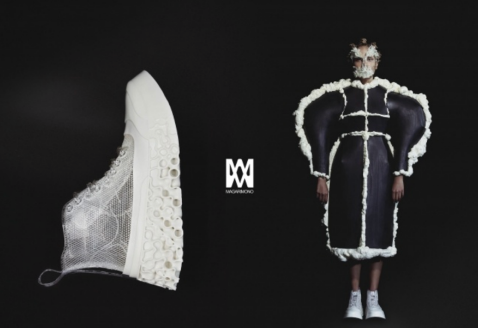
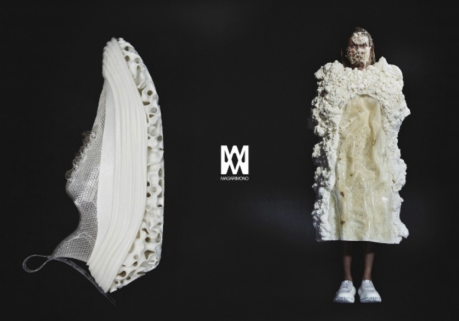
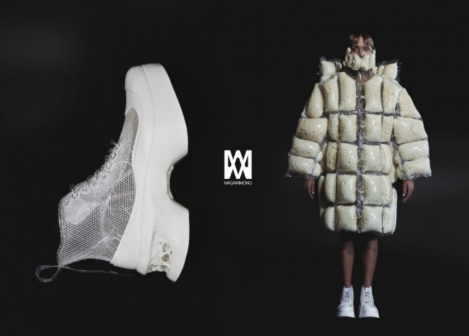
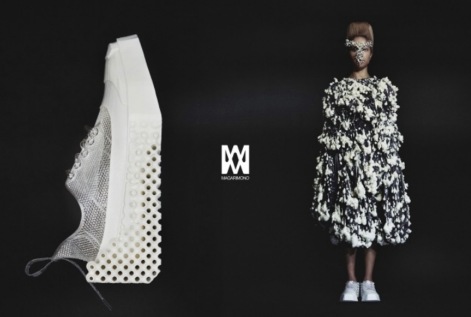
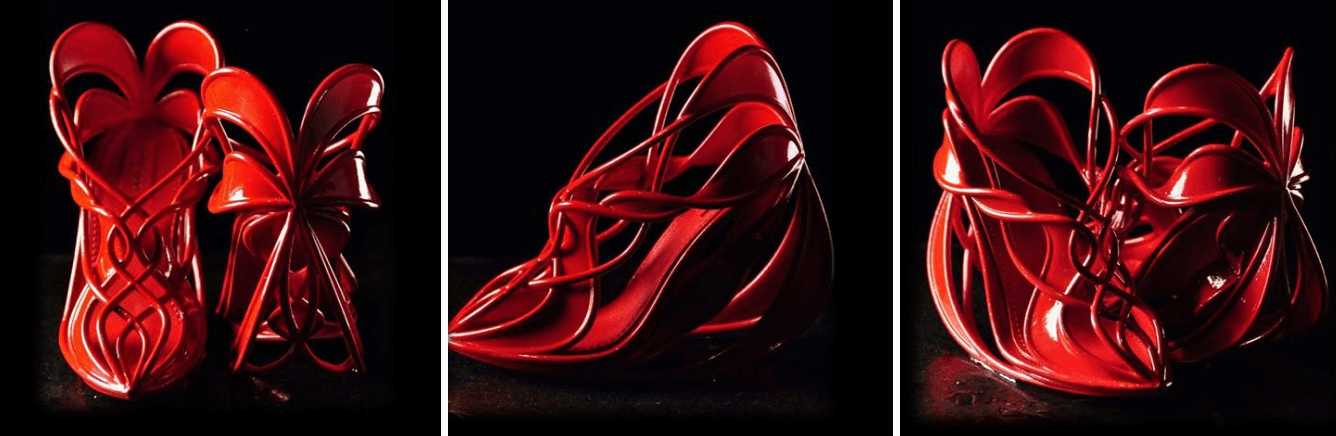
Possibilities through fusing material and technology.
Processes never before challenged.
We aim for footwear capable of meeting such goals.
-MAGARIMONO.com
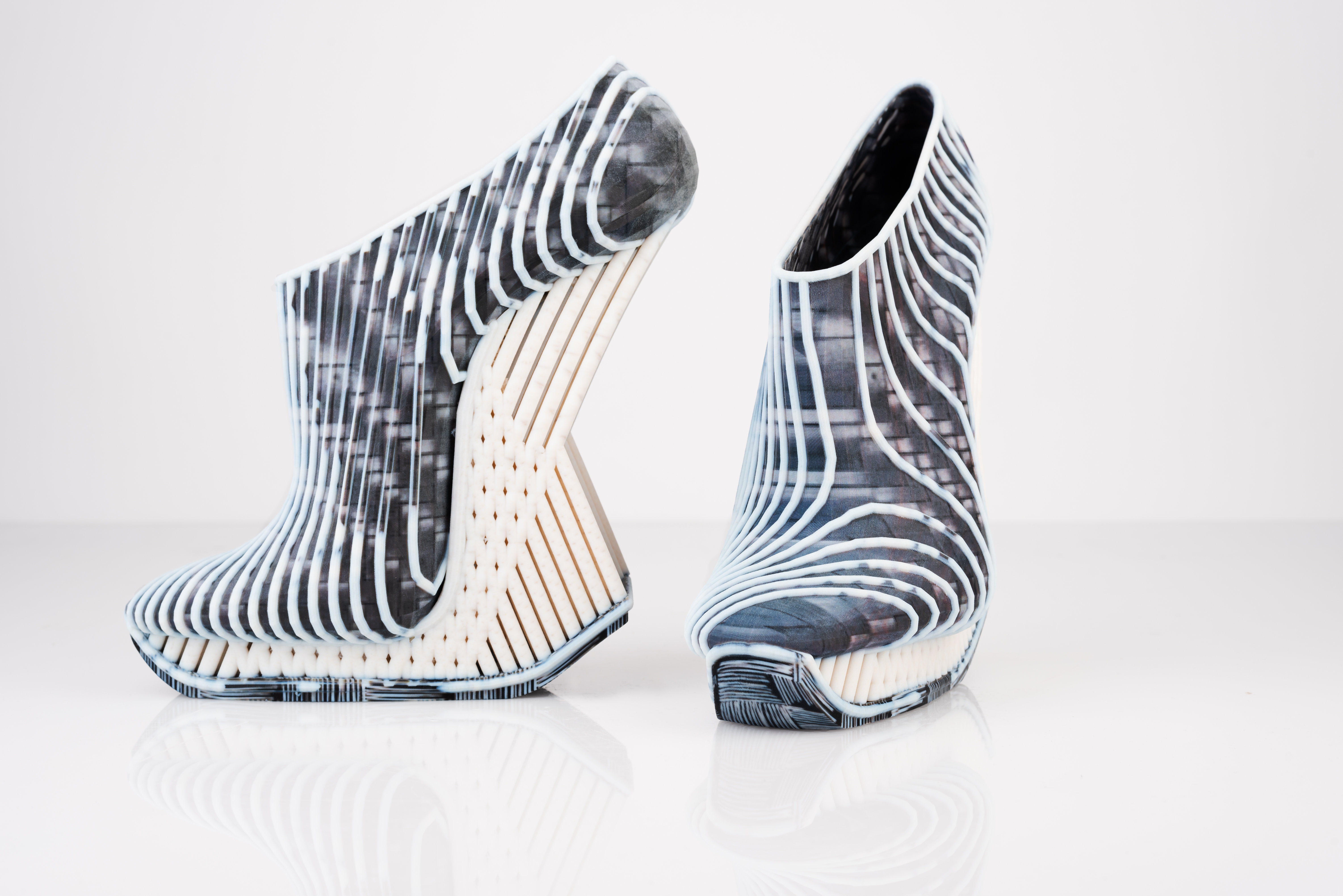
High-fashion is getting another boost from high-tech as Hangzhou-based Shining 3D collaborates with MAGARIMONO, a Japanese company manufacturing designer footwear. Endeavoring to send their clientele walking on clouds, Shining 3D and MAGARIMONO have teamed up to create four new designs for the MAGARIMONO ORIGINALS CLOUD Collection.
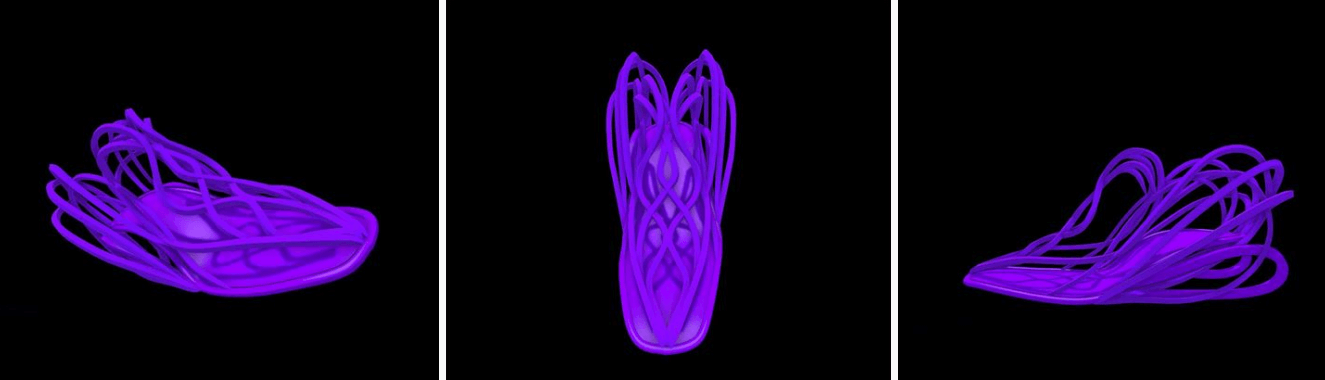
While most consumers want aesthetically pleasing shoes that are also comfortable (not always an easy ‘feat’ to pull off), the designers invoke the concept of cushiony luxury combined with allusions to the four different types of clouds: cumulus, cirrus, stratus and nimbus.
“The design incorporates an amorphous shape in which water circulates while changing shape, such as bubbles, waves and clouds,” explains the MAGARIMONO team in a recent press release sent to 3DPrint.com regarding the project.
Although most famous for manufacturing of the EinScan series of scanners and 3D printers using FDM, SLA, SLS and SLM technology, this is not Shining 3D’s first experience in working with footwear manufacturers; in fact, they have contributed to the success of other famous shoe brands in China, and continue to grow in that space through offering greater numbers of shoe soles worldwide, printed with TPU on their SLS printers.
“Digital modeling and 3D printing have enabled today´s designers to create novel objects of previously near-impossible form,” said Eric Ludlum of Core77. “Elaborate shapes have become a hallmark of the medium but thankfully form-giving as a practice has pulled back from a complete embrace of the aesthetic and now finds success with a restrained mix of those digital flourished with classic surfaces.
“Japanese brand MAGARIMONO manages this trick in their new line of shoes. What makes it an interesting launch is that they´ve taken some of the creative strangeness cut from the formal resolution, and found a place for it elsewhere in their overall creative package. It counteracts the seriousness and sterility that can build up in tight digitally-enabled product development loops.”
The advantages of 3D printing are on full display here as customized shoes are fabricated for consumers, allowing them to choose the type of cloud they would like to ‘walk on.’ Cloud pattern soles are then produced on the Shining 3D EP-C5050 Pro TPU 3D Printer, continuing with the concept of condensation in the form of ‘waterdrops,’ and the continued ‘transformation of the elements’ as imagined by the MAGARIMONO designers.
“Julia Koerner is an award-winning Austrian designer working at the convergence of architecture, product and fashion design. She is internationally recognised for design innovation in 3D-Printing, Julia’s work stands out at the top of these disciplines,” her website states. “The constantly intriguing aspect of Julia’s work is its embodiment of a beautiful organic aesthetic.”
She was one of 15 designers chosen by non-profit organization Austrianfashion.net to show her work—the 3D printed Setae jacket—at its recent Virtual Design Festival (VDF). The organization is a platform that is focused on promoting contemporary Austrian fashion designers and partnered with VDF to exhibit innovative fashion designs and accessories by designers who were either born, or are currently based, in Austria, and also produce their work locally and sustainably.
Austrianfashion.net said, “[Körner’s] work on the future of 3D, as well as on its current applications, can be seen as revolutionary practice. Strongly believing that the future of fashion is 3D, Körner is making sure she is at the forefront of the revolution.”
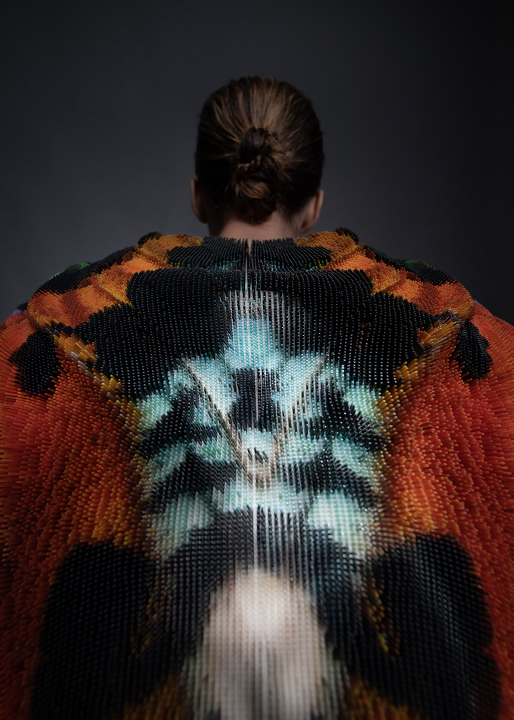
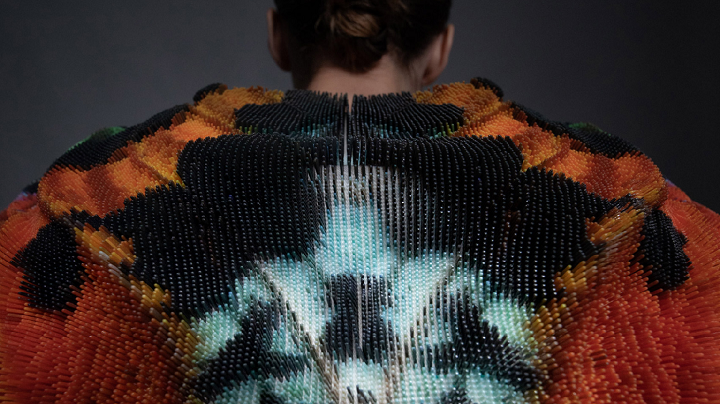
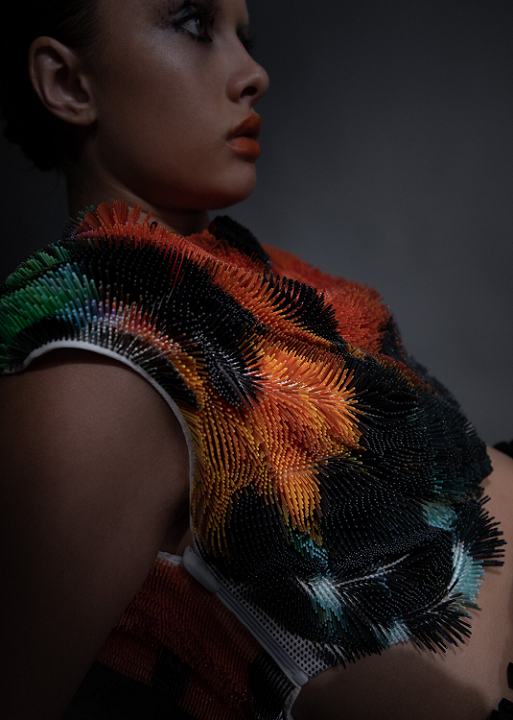
Her beautiful, 3D-printed Setae Jacket is part of the 3D printed Chro-Morpho fashion design collection by Stratasys, which we’ve discussed here before, and was also inspired by colorful butterfly wings. The collection is meant to show how technology and textiles can work together, and even create commercially viable pieces of clothing. The jacket was 3D printed out of flexible Vero material on one of the company’s multimaterial printers, either the J750 or the J850, and every bristle resembles setae, which is a stiff structure akin to a hair or a bristle.
“The research explores digital setae pattern design and multi-color 3D printing on fabric, inspired by microscopic butterfly wing patterns. Butterfly wings are made up of membranes which are covered by thousands of colorful scales and hairs, plate-like setae,” Körner’s website states.
She used photographs of Madagascan Sunset Butterfly wings, and the setae on the wings were actually digitized into an algorithm, “which translates the color pixels into 3D bristle patterns which correspond to the form of the garment design.”
“The digital designs are 3D printed in an innovative way, without any support material and directly on fabric,” the site continues. “The relation between the colourful rigid setae and the flexible fabric create enigmatic visual effects when the garment is in motion.”
To form the jacket, the bristles were 3D printed on denim. When the garment is worn, the setae move along with the person, which is a really interesting effect.
“Due to the movement and delicate color transformation, it expresses a true organic animal flow that comes to life,” Stratasys states.
Do I spy a zipper?
It is definitely a unique piece, and while lack of comfort and wearability is always one of my biggest critiques when it comes to 3D-printed fashion, the Setae Jacket absolutely looks wearable to me.
What do you think? Discuss this story and other 3D printing topics at 3DPrintBoard.com or share your thoughts in the comments below.
If you don’t remember the stunning and technical work from Anouk Wipprecht—the Dutch fashion design working on “rethinking fashion in the age of digitalization” by combining engineering, fashion, robotics, science, and interaction/user experience in an emerging field known as FashionTech—let me refresh your memory. Noting that fashion lacks microcontrollers—something I never would have thought about—Wipprecht is an amazingly unique designer, who wants her clothing to, according to her website, “facilitate and augment the interactions we have with ourselves and our surroundings.”
“In a future where electronics are predicted to be embedded in everyday objects, – what kind of clothes will we wear? Will future techno fashion be purely aesthetic – or will it expand our awareness, acting like an intelligent second skin? Will we become super sensory, physically aware of data flows, communicating our internal states through the garments we wear? And, most pertinently perhaps, how will we socialize in our world when we are supervised by technology?”
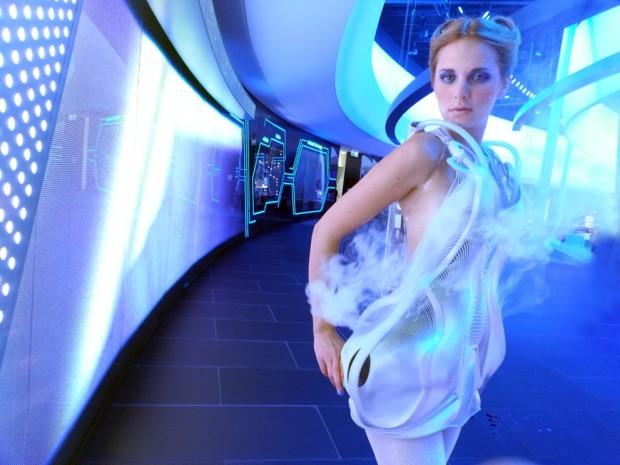
Anouk Wipprecht’s Smoke Dress
Back in 2014, Wipprecht launched a campaign to create the first crowdsourced 3D-printed dress, and followed this up with her Synapse Dress, partnering with Materialise, Niccolo Casas, and Intel to create a wearable that leverages the wearer’s own electrical currents for a fully immersive experience. The designer later combined 3D printing with virtual reality to create a collection of dresses for Audi, and worked with model and musician Viktoria Modesta to fabricate 3D-printed prosthetics for musical performance.
Now, the high-tech futurist designer is back with two new 3D-printed wearables that could be very useful in this time of social distancing, due to the continuing COVID-19 crisis: the Proximity Dresses, Robotic Personal Space Defenders.
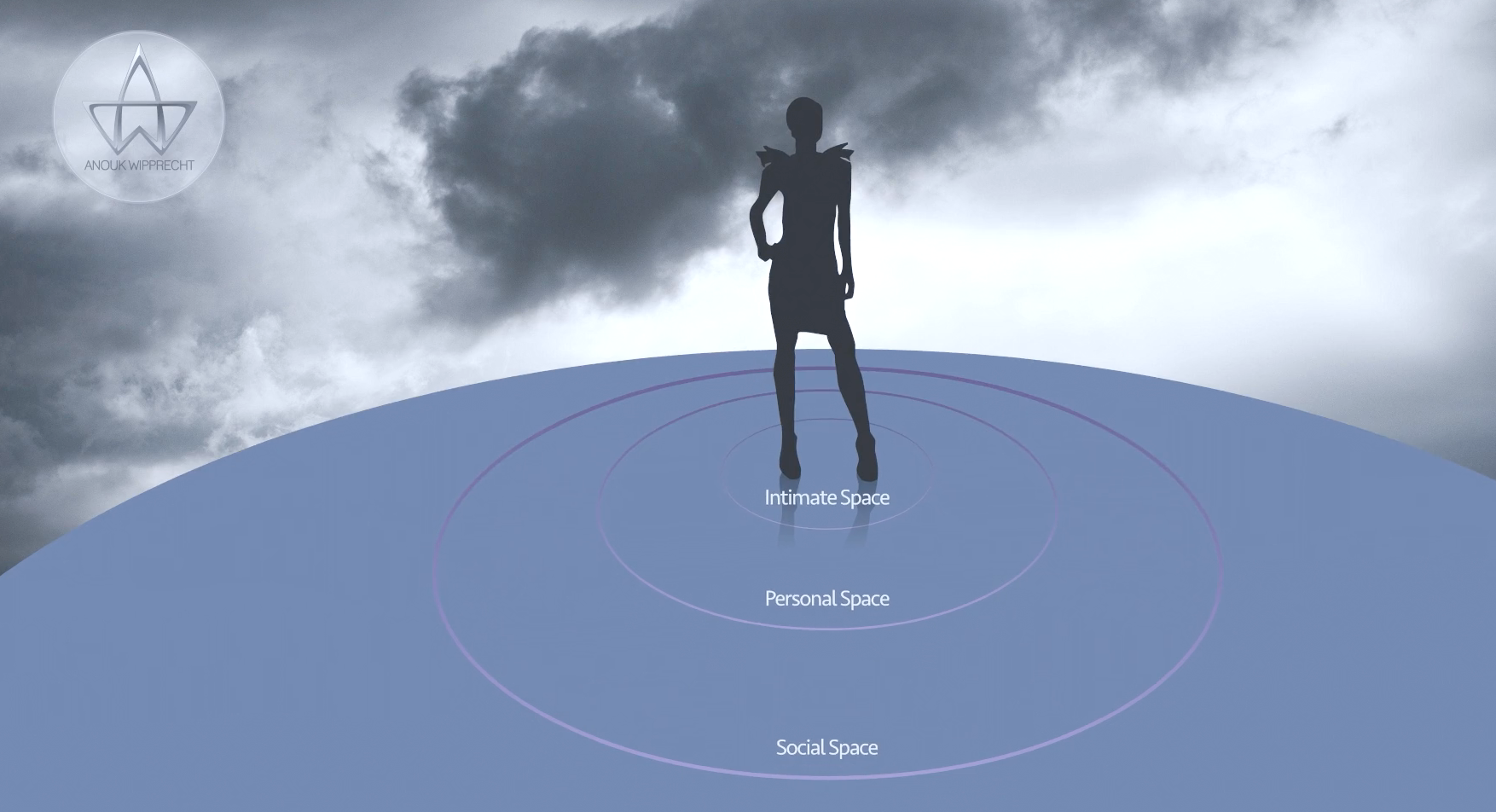
“Extending my research into proxemics and the body, I have fabricated two new dresses that create physical barriers when a person is detected in the immediate surroundings of the wearer,” Wipprecht said. “These twin dresses respond based on proximity and thermal sensors and indicates strangers within the intimate, personal, social and public space around the wearer.”
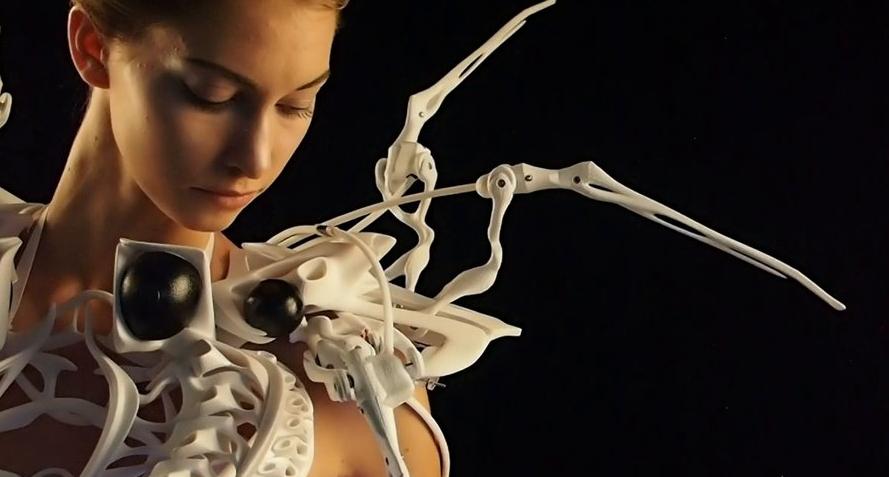
As with Wipprecht’s Smoke Dress and 3D-printed, robotic Spider Dress, which literally moves itself into an attack position if the embedded proximity biosensors detect that the wearer is uncomfortable, the design for these new dresses is based on Edward T. Hall’s Proxemics Theory. She explains that the theory defines “four spaces around the body,” each of which has its “own characteristic distances.”
Anouk Wipprecht’s 3D-Printed Spider Dress
“Whereas Hall had to measure the space between people using a wooden stick, I have been working since 2007 to translate these concepts into the digital domain, in order to measure the spaces between people up to a range of 25 feet,” she explained.
The Proximity Dresses use robotic, nylon 3D-printed hip mechanisms to extend when necessary. Additionally, they feature a transparent collar, 3D printed from clear resin, with some fancy sensors that offer noise-free distance readings.
Anouk Wipprecht’s Proximity Dress
These sensors use “high-output acoustic power combined with continuously variable gain, real-time background automatic calibration, real-time waveform signature analysis, and noise rejection algorithms. This holds true even in the presence of various acoustic or electrical noise sources, making it suitable for on-body use.”
By using the sensors, Wipprecht’s unique designs can invisibly trace their surroundings. Additionally, since the sensors don’t record any images or video, the dresses are not a threat to privacy, as nearby people remain anonymous.
“The Proximity Dress 2.0 is based on my 2012 prototype of this dress using hip mechanics create distance and a proximity sensor (ultrasonic rangefinder) for VW showcase during IAA, in Germany,” she concludes.
Check out the video below to see Wipprecht discuss her innovative, defensive Proximity Dress with Hyphen-Hub:
Discuss this story and other 3D printing topics at 3DPrintBoard.com or share your thoughts in the Facebook comments below.
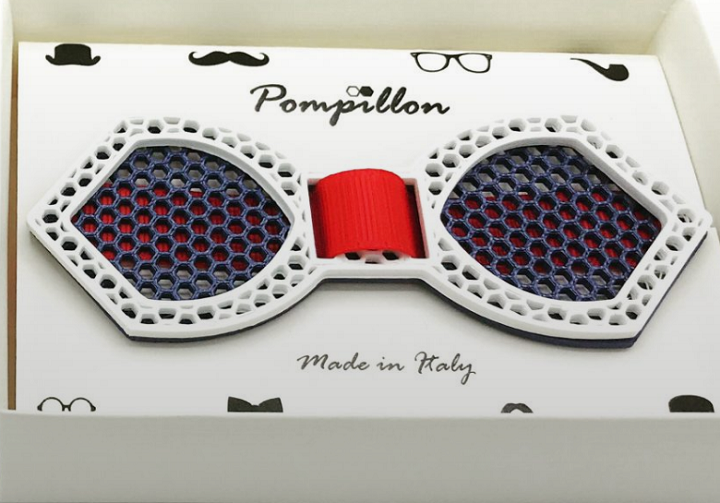
There’s something fantastically dapper about a bow tie, and a 3D printed version definitely takes this fashionable look the extra mile. Ties and bow ties, along with ascots and scarves, were born from the cravat, and can quickly elevate an outfit. But using 3D printing to make these fashion-forward accessories means that you can easily play with the shape and texture of the tie for a more unique aesthetic.
Pompillon, a clothing brand based in Italy and Germany, was founded in 2017, based on an idea from bow tie collector and aerospace engineer Luca Pompa, also the founder of the brand. That idea, of course, was to use 3D printing to make more creative, customizable bow ties. The name Pompillon is a playful merger between the surname Pompa and ‘papillon,’ which the website explains is “the French name of the beloved bow tie.”
“The vast assortment of colors of bow ties and combinable ribbons wants to encourage everyone’s imagination to the maximum, to personalize his style with a small accessory with attention to every detail,” the Pompillon Facebook page states. “Moreover, the various editions will allow collecting them in all its lines.”
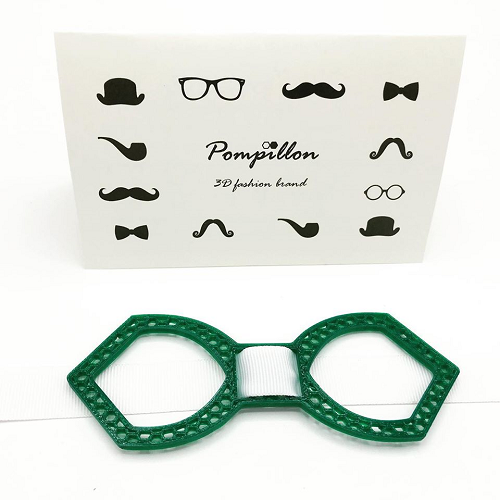
3D printed Pompillon bow ties merge classic shapes with creativity, experimentation, and technology; add in attention to detail and a wide range of ribbons and tie colors, and the sky is the limit when it comes to personalizing your style. The Pompillon tie takes the typical bow tie silhouette, reduces it down to the most essential lines, and reinterprets the accessory with 3D printing.
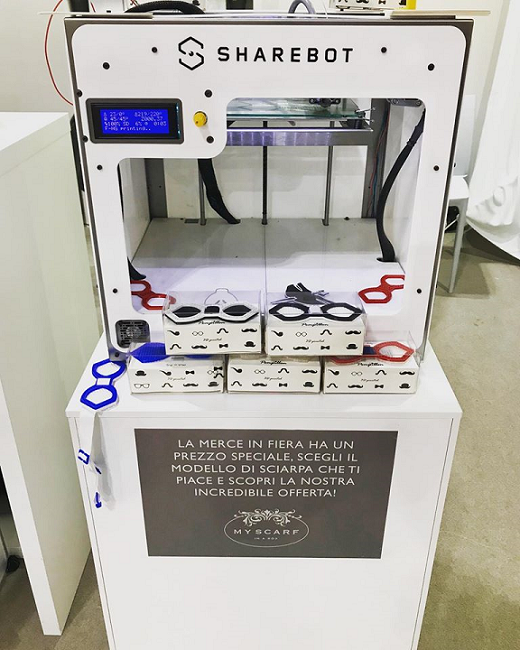
The brand uses another Italian original to fabricate its bow ties – Sharebot 3D printers. Pompillon bow ties are 3D printed using a hexagon infill shape. Several of these six-sided polygons, all with sides of equal length, are joined together to make the bow tie and optimize “structural packing to the maximum.”
3D printed Pompillon bow ties are perfect for classic, everyday style, and for more formal occasions as well. The brand’s ideal clientele are those who appreciate a personalized and colorful look, as they enjoy dressing in a refined way, without being boring.
The bow ties are 3D printed out of plant-based, biodegradable PLA material from renewable resources, which keeps them lightweight. In the future, Pompillon will make special editions of its bow ties out of carbon fiber, marble powder, and even wood.
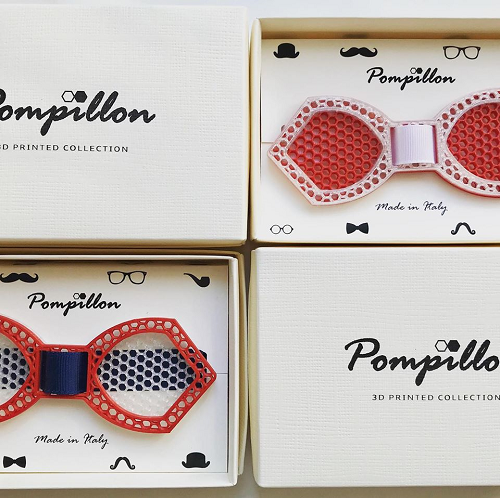
Pompillon has two versions of its bow tie – the filled Gentlemen and the open Rebel. When you combine the two, it makes the Unique model. The brand also offers a Gala Edition bow tie, which appear to only come in black and white for more sophisticated evenings, à la James Bond. These 3D printed bow ties are completely customizable with a variety of colors, clips, and ribbon, so you have a lot of choices to play around with in making your own unique accessory.
You can visit the brand’s online shop page to see what’s available. Two of the looks I really like are the Pompillon Dark Rebel, which is a red ribbon and black bow tie combination for just €24.90, and the Pompillon Unique White Snow & Blue Ocean, also at a price of €24.90. A 3D printed Gala Edition bow tie will set you back just €26.90, and several of the Pompillon Gentlemen ties, including my favorite in the limited edition Nature Green color, only cost €19.90.
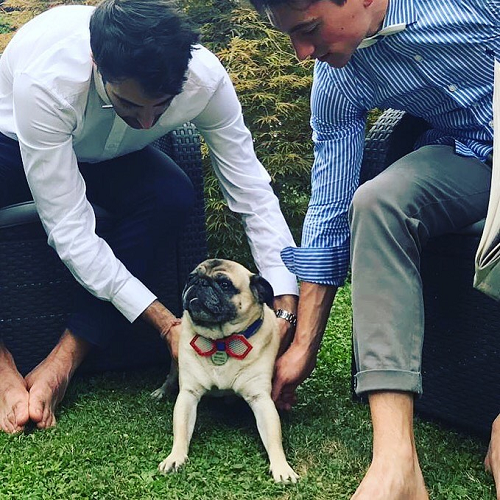
They even look good on dogs!
“Have fun using them in bulk or combined with our other Pompillon. Make it unique and customizable for every look and mood,” the shop page says.
“Take a picture wearing it and post it on social media. If you send it to info@pompillon.it, it will be published and advertised on our social networks! plus you will have the chance to win a free one…be Lucky!”
Would you wear a 3D printed Pompillon bow tie? Let us know! Discuss this story and other 3D printing topics at 3DPrintBoard.com or share your thoughts in the Facebook comments below.
In today’s 3D Printing News Briefs, we’ve got a little business news, followed by stories about materials, and finally ending with some 3D printed fashion. PostProcess Technologies is expanding in Japan with a new partnership. Smart International has launched a material partnership program, and CRP Technology is introducing a new Windform material. Finally, a Spanish fashion brand is using BCN3D’s technology to make some of its clothing.
PostProcess Technologies Enters Asian Market with New Partnership
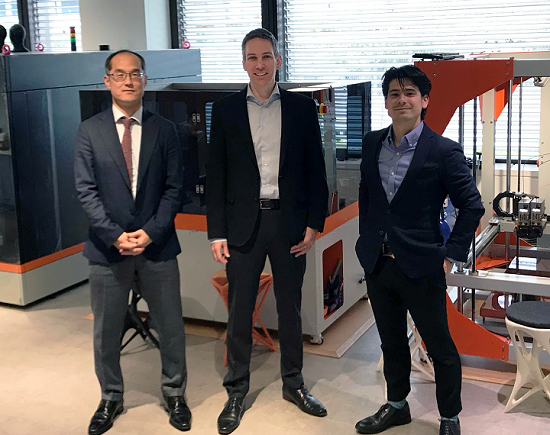
Executives from PostProcess and K.K. IRISU (C. ILLIES & CO., LTD.)
Automated post-printing solutions provider PostProcess Technologies Inc. announced that it’s entering the Asian additive manufacturing market, and expanding the reach of its solutions, by naming K.K. IRISU (C. ILLIES & CO., LTD.) as its first distribution partner in Japan. PostProcess chose the high-quality industrial machinery and technologies specialist, to help serve its growing base of customers in Japan and represent its data-driven technologies because of its expertise and experience. The partnership is mutually beneficial, as ILLIES can now offer its customers access to technology that will automate common post-printing processes and enable “additive manufacturing at scale.”
“K.K.IRISU’s main objective is to educate the Japanese market in additive manufacturing and to continue to be the solution provider for the Japanese 3D manufacturing world. We feel that by adding PostProcess Technologies to our lineup, will help assist the Japanese market to compete with other countries in Additive Manufacturing as well as globally maintain the high standards of the tag ‘Made in Japan’,” said Dr. Frank Oberndorff, President of K. K. IRISU.
Next month, both companies will exhibit at the Design Engineering & Manufacturing Solutions (DMS) 2020 Expo.
Smart International Introduces Material Partnership Program
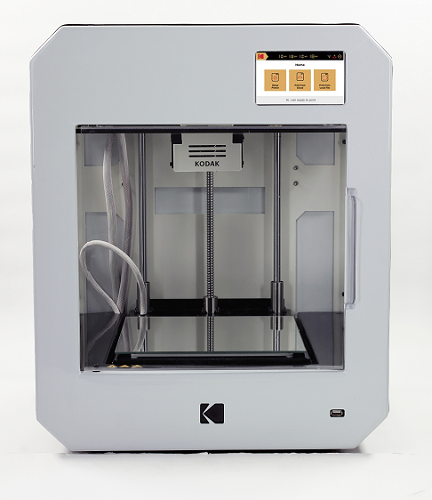
This week, Smart International, the global brand licensee in 3D printing for KODAK, announced the launch of a new Materials Partnership Program in order to help its customers achieve a repeatable 3D printing experience, while also meeting the demand for high-quality, yet easy-to-print, engineering materials. The company has already developed, and tested, material profiles for filaments from its partners BASF, Clariant, and DSM, which will help provide optimal conditions for these third party materials on the Portrait 3D printer. Print profiles were created from this data, and can either be accessed from the KODAK 3D Cloud or downloaded from the Smart3D website.
“We feel it is of vital importance to continually adapt to the ever-evolving 3D printing market. Partnering with top filament companies like BASF, Clariant and DSM gives the customer the opportunity to choose the material that best fits their project, and gives them confidence to use these high-quality 3rd party materials with the KODAK Portrait 3D Printer,” said Roberto Gawianski, the CEO of Smart International. “We are pleased to be able to assist in the development and evolution of 3D printing filaments, and will continue to support progress in this area.”
BASF material profiles include Ultrafuse ABS Fusion+, Ultrafuse PAHT CF15, Ultrafuse PA, and Ultrafuse Z PCTG, while Clariant now has a profile for its popular 20% carbon fiber-reinforced polyamide 6/66 PA6/66-CF20 filament. Smart International also created material profiles for DSM’s Novamid ID1030, Novamid ID1030 CF10, a carbon fiber filled PA6/66 copolymer filament and Arnitel ID2060 HT.
CRP Technology’s New Windform P2 Material
Italian company CRP Technology is introducing the latest material from its Windform P-LINE range – the glass fiber-reinforced thermoplastic polyamide Windform P2, which the company states has “excellent mechanical properties” for its High Speed Sintering (HSS) technology. The new material has high tensile strength (39.24 MPa), combined with increased stiffness (2925.20 MPa), and is great for insulating, as it is glass fiber-filled. Windform P2 is good for producing end-use parts that need high stiffness, as well as manufacturing components with detailed resolution.
“Windform® P2 is the second polymer from P-LINE, the new Windform® range of materials for high speed production-grade 3D printing, introduced on the market less than a year ago,” said Engineer Franco Cevolini, CRP Technology CTO and VP.
“This is a very important property. Windform® P2 is stiffer than Windform® P1 because Windform® P2 is reinforced (Windform® P1 is not reinforced). Most of the reinforced materials for similar technologies currently on the market, show a decrease in the tensile strength property. My staff and I have been able to preserve the high tensile strength in Windform® P2. Therefore, Windform® P2 overall’s performance is superior than the performance of similar materials currently on the market for similar technologies.”
ZER Collection 3D Printing Clothes with BCN3D
The 3D printed parts are made in TPU due to the flexibility of this material.
Spanish fashion brand ZER Collection introduced its first collection at the most recent Mercedes Benz Fashion Week in Madrid. The label, which was founded in 2017 by Núria Costa and Ane Castro and designs ‘futuristic, functional and urban clothing with sporty aesthetics,’ incorporated 3D printed parts, made with BCN3D’s Sigma printer, into 12 of the outfits; this system allows for the printing of two different materials, including flexible TPU. ZER Collection is using 3D printing in order to accelerate its production manufacturing processes and reduce waste, while also contributing to the use of sustainable new technologies in the apparel industry.
“We work much faster, because we can print two fabrics at the same time,” Costa said when explaining some of the benefits of using 3D printing to make their clothing, including their ability to “digitize all patterns in order to produce only the necessary fabric.”
“We believe that the use of 3D printing represents a revolution in fashion, in environmental care and in society.”
Discuss these stories and other 3D printing topics at 3DPrintBoard.com or share your thoughts in the Facebook comments below.
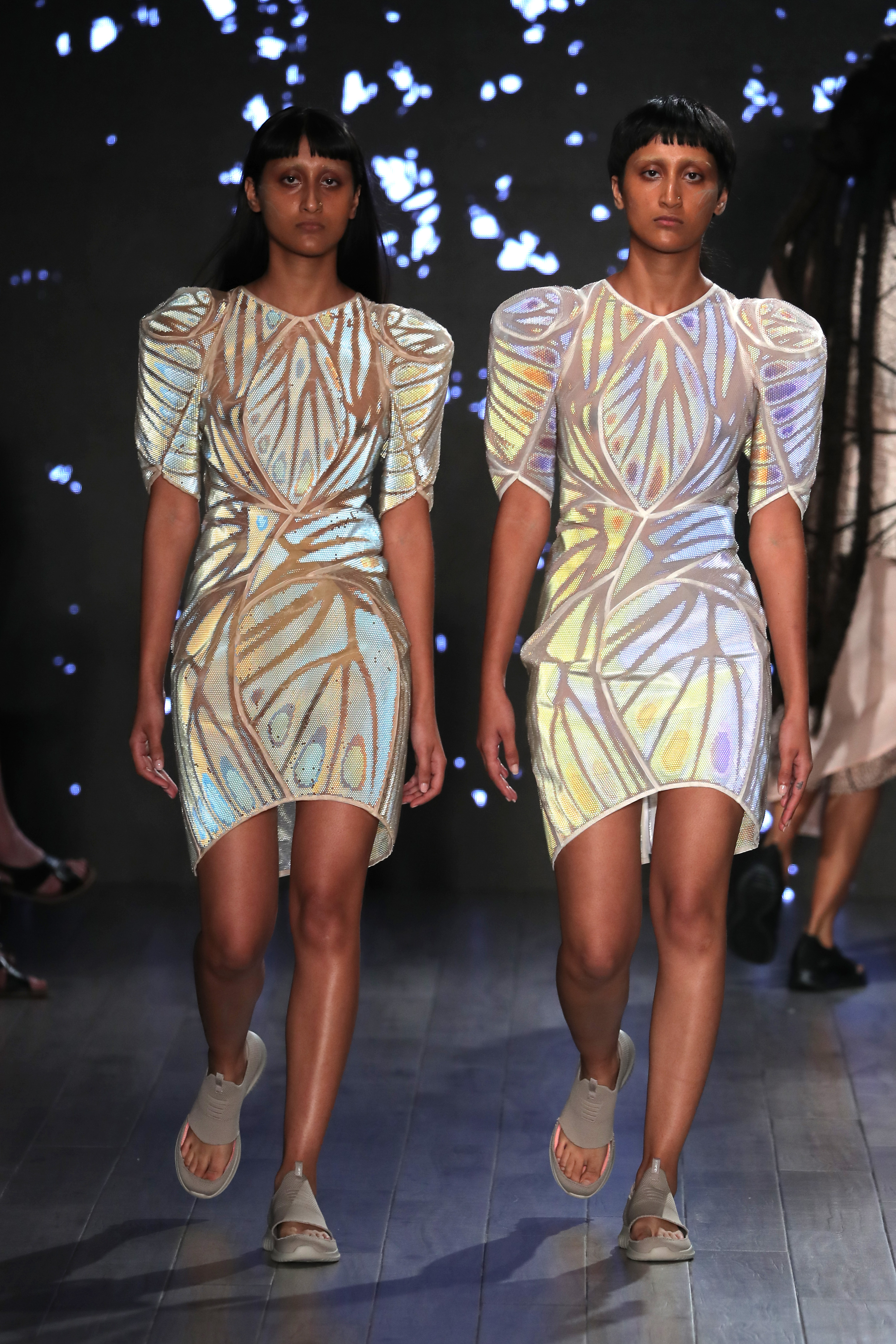
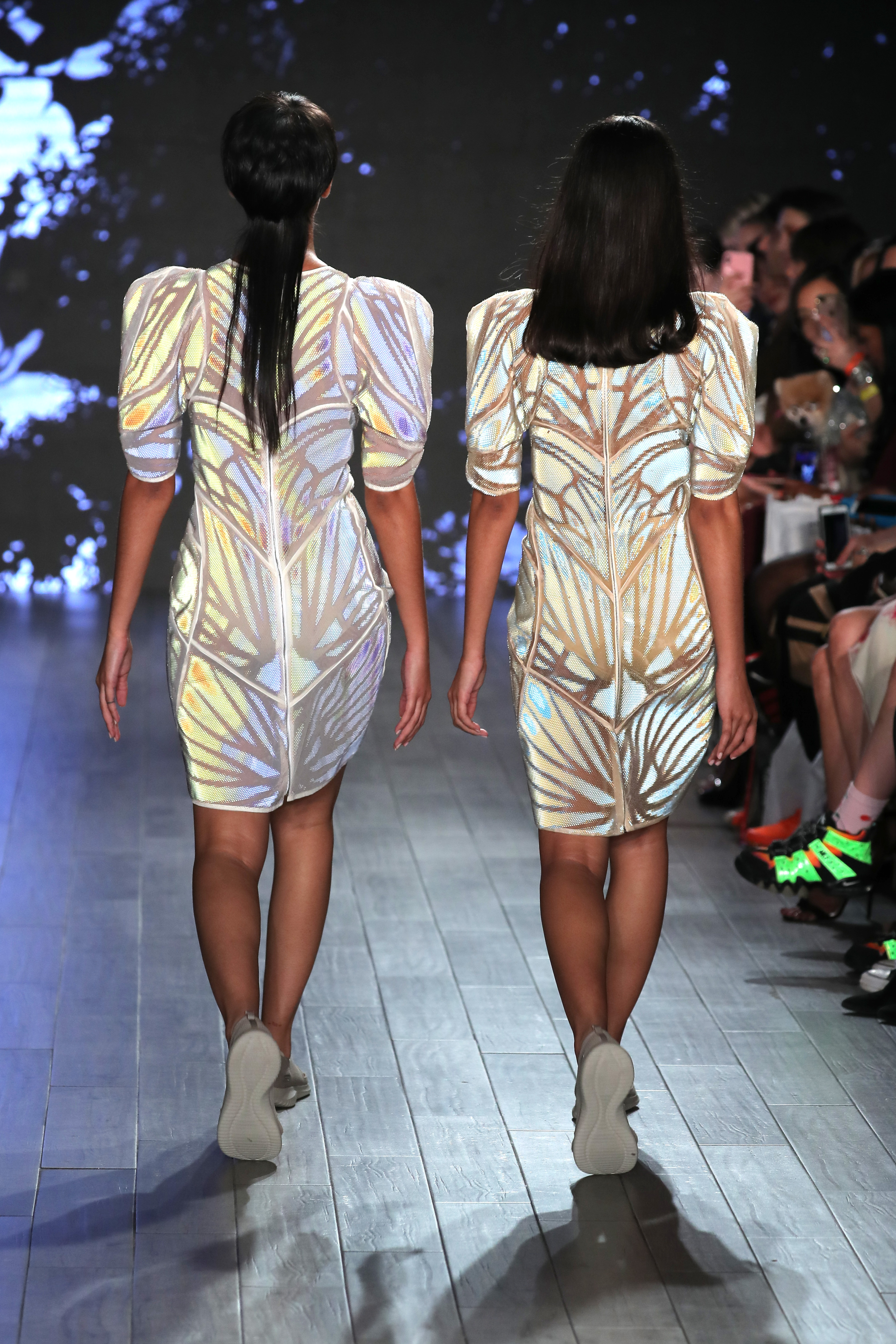
NEW YORK, NEW YORK A model walks the runway during threeASFOUR Runway Show hosted by Klarna STYLE360 NYFW on September 11, 2019 in New York City. (Photo by Thomas Concordia/Getty Images for Style360)
Years ago, New York City design firm threeASFOUR founded an avant garde fashion label that frequently uses 3D printing in its garments, which we’ve seen at previous NYFW events. For the September 2019 series, the company teamed up again with frequent collaborator Stratasys for a truly innovative runway look: the first high fashion garment with elements that were 3D printed directly onto the fabric itself. The Chro-Morpho collection, introduced at the firm’s fall/winter runway show, shows that 3D printing on clothing has commercial potential.
“This has significant implications from a business perspective,” Craig Librett, the Senior Public Relations & Public Affairs Manager for Stratasys, told us. “Instead of creating elements separately – and manually affixing them later – this new technique enables fashion houses and brands to develop hundreds of exclusive pieces with 3D printed elements that can be sold and worn on the mass market.”
With a few exceptions, most 3D printed fashion consists of elements that are 3D printed separately, and later affixed to the garment itself. But Stratasys believes that 3D printing directly onto textiles could really help open up the technology’s “commercial viability” in terms of functional, flexible, and modern apparel.
“Within the next two years, I believe consumers will be able to purchase an array of 3D-printed garments from high-fashion brands. And the result will be access to an explosion of unique color and texture combinations that are simply not possible through traditional methods,” Stratasys Art, Design and Fashion Director Naomi Kaempfer said in a press release.
NEW YORK, NEW YORK A model walks the runway during threeASFOUR Runway Show hosted by Klarna STYLE360 NYFW on September 11, 2019 in New York City. (Photo by Thomas Concordia/Getty Images for Style360)
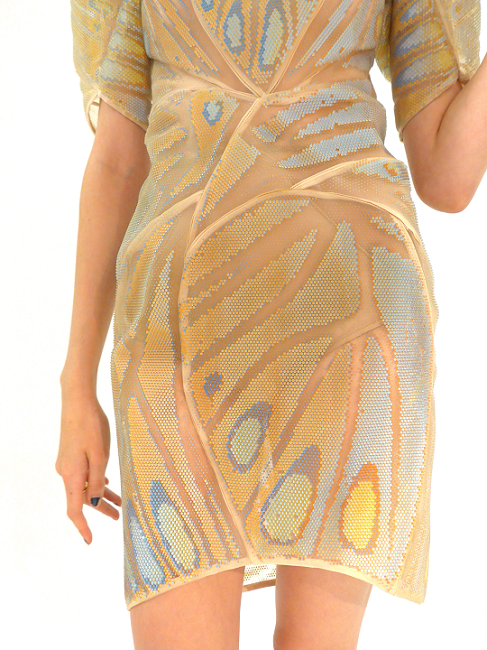
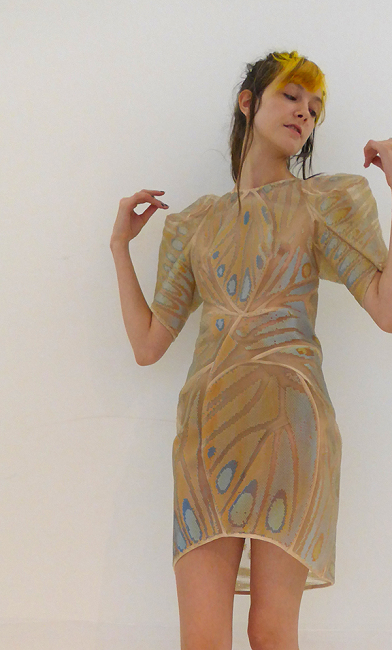
Stratasys worked with threeASFOUR and fashion designer Travis Fitch to create the Chro-Morpho collection, which was inspired by the color morphology and light filtering of butterly and insect wings. For instance, a Greta-Oto dress from the collection uses a lenticular effect, engineered by Stratasys, to play with both color and light – spherical cells made of photopolymers the size of fish scales were 3D printed directly onto polyester, which causes the piece’s color to shift each time it moves.
“We’ve created the skin-like illusion of switching shades and depth to portray the insect’s innate camouflage, color diversion and luminosity. With 3D design and printing, we’ve embodied the fragility and light wing movement of the butterfly. It’s a stunning display of nature, fashion and technology,” explained Adi Gill, Co-Founder and Creative Director of threeASFOUR.
The dress has 27 parts made up of thousands of cells – each piece is made up a clear lens that contains strips of color inside. All told, it took about 17 hours to 3D print the polymers onto the dress using the Stratasys J750 3D printer, which just made its NYFW debut but has been previously used in fashion 3D printing.
The full-color, multimaterial PolyJet 3D printer is able to produce over 500,000 different combinations of colors, gradients, textures, and transparencies. Designers can enjoy more design freedom, as the system is able to handle the microscopic layers and delicate geometries of 3D printed garments, and the J750 is also beneficial to a designer’s business, as it can replace multiple manufacturing machines, make the supply chain simpler, and save on time, cost, and space.
This latest NYFW project with threeASFOUR and Fitch is a major step forward for Stratasys in its quest to combine 3D printing with fashion for high-end clothing and, hopefully, series production in the future, for those of us who can’t afford clothing pieces right off the runway. According to Kaempfer, 3D printed fashion is more about working with fabric materials, instead of just replacing them.
“Soft, lithe fabric touches the skin, while 3D-printed designs adorn the outer garment,” Kaempfer said. “This approach, developed through months of collaboration and testing, was the only way to realize the designers’ vision. It brings the intricacy, nuance and splendor of the dresses to life.”
In order to encourage artists, designers, engineers, and scientists to explore using 3D printing for fashion, Stratasys is also providing its PolyJet technology to the European Union Re-FREAM program, which is funded by the EU’s Horizon 2020 program and part of the broader Science, Technology & the Arts (STARTS) initiative.
Kaempfer explained, “We are always looking to revolutionize manufacturing methods, pioneer new design options, and inspire designers and students to create without boundaries. Our mission is to change the way people think about design and to redefine what’s possible.”
The collaborative, 3D printed Chro-Morpho collection will travel around to museums across the US once NYFW is over. Starting on October 21st, you can see it on display for yourself at the Philadelphia Museum of Art’s “Designs for Different Futures” exhibition, and in 2020 the collection will head to both the Art Institute of Chicago and the Walker Art Center in Minneapolis, Minnesota.
Discuss this story and other 3D printing topics at 3DPrintBoard.com or share your thoughts in the Facebook comments below.
“The world doesn’t need more shoes, but it deserves innovation.” – Annie Foo
The Annie Foo Design company is busy fashioning the future. A London local who is embracing the 3D printing trend, designer Annie Foo is currently working to complete her master’s degree in fashion at the Royal College of Art. In using Gravity Sketch (also employing virtual reality), she has been able to design and then 3D print her works, consisting of high-tech, fashionable shoes, on an HP Multi Jet Fusion 4200.
Foo recognizes the importance of 3D printing around the world, in fashion and shoes, and especially as she has watched the technology ‘pick up steam over the last several years.’ Along with that, 3D printing has infiltrated nearly every avenue of industry, helping to make everything from extremely important medical devices to auto parts, aerospace components, construction, and comprehensive manufacturing.
Foo Design sees 3D printing as ‘just getting started,’ however, in terms of fashion. Realizing the importance of finding her own niche in the fashion business, Foo has been using the progressive technology more often.
“Passionate about sustainability and moving away from the disposable aspect some parts of the fashion industry have turned to recently she researched the best way to print her shoe designs that would offer flexibility, durability and speed,” state the researchers. “The HP Multi Jet Fusion 4200 presented a solution.”
And while the customized shoes are beautiful in design, presenting a serious artistic flair, the shoes are functional. Annie Foo has just begun producing 3D printed shoes for her customers and is working with her first now by 3D scanning the foot and then creating a ‘bespoke’ shoe. Pricing is still being decided on.
Employing the benefits of 3D printing allows for faster turnaround in the product, greater affordability, and better customization, Annie Foo also believes in fighting waste overall. The collection of Annie Foo’s shoe designs can be viewed on Instagram here.
3D printing continues to play a larger role in fashion today, and especially in shoes. While we have seen examples from other fashion designers too that are not quite as realistic for the mainstream in that they are mainly almost considered to be works of art—rather than works of comfort or sensibility—companies like Nike and Adidas have taken off with additive manufacturing and ‘run with it,’ adding 3D printed uppers, materials overall, and items like 3D printed lacelocks.
Other fashion designers have been involved in creating a wide range of dresses, some of which are haute couture and would never be worn in daily life, and then other pieces that are more casual and appealing for realistic consumers.
What do you think of this news? Let us know your thoughts; join the discussion of this and other 3D printing topics at 3DPrintBoard.com.
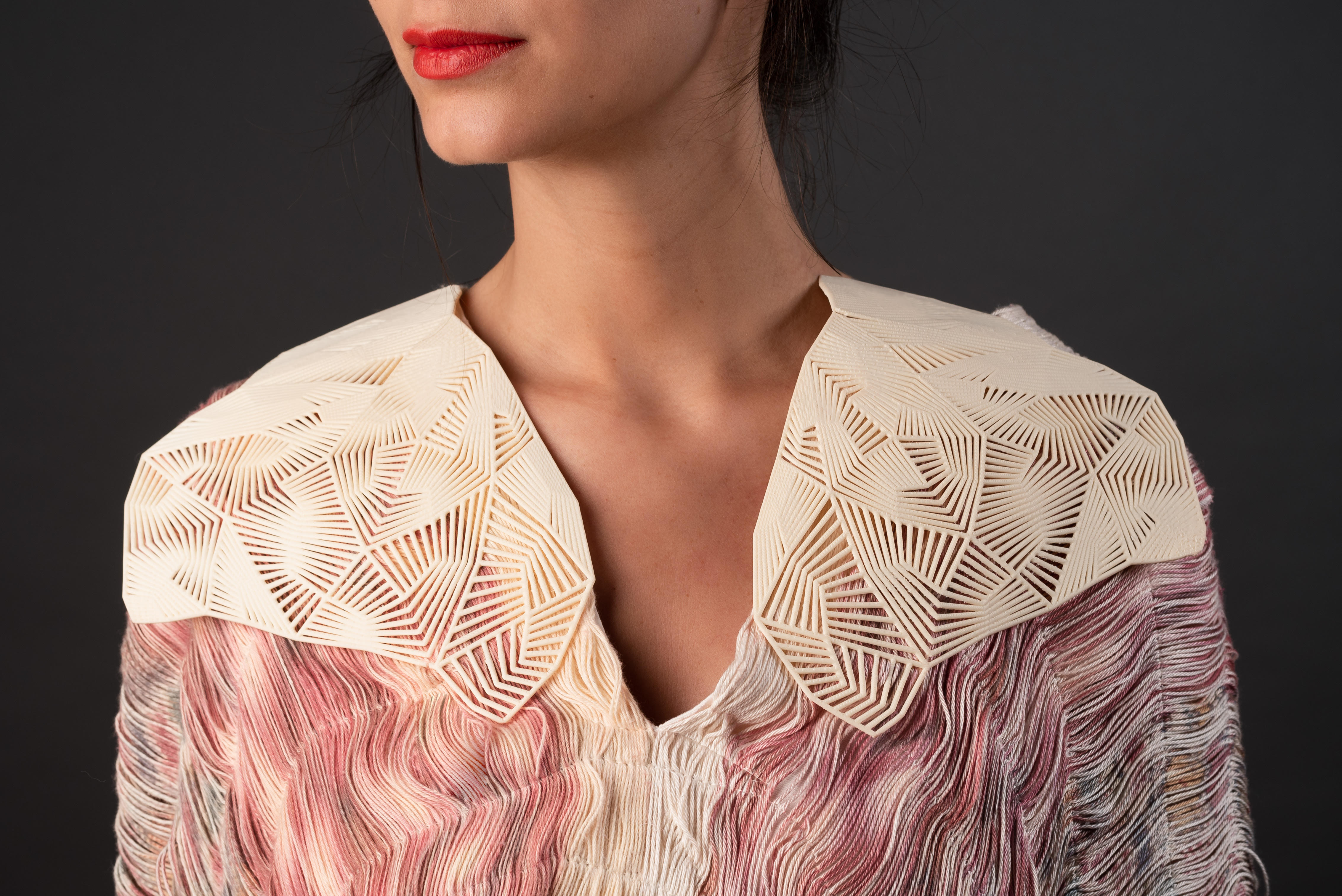
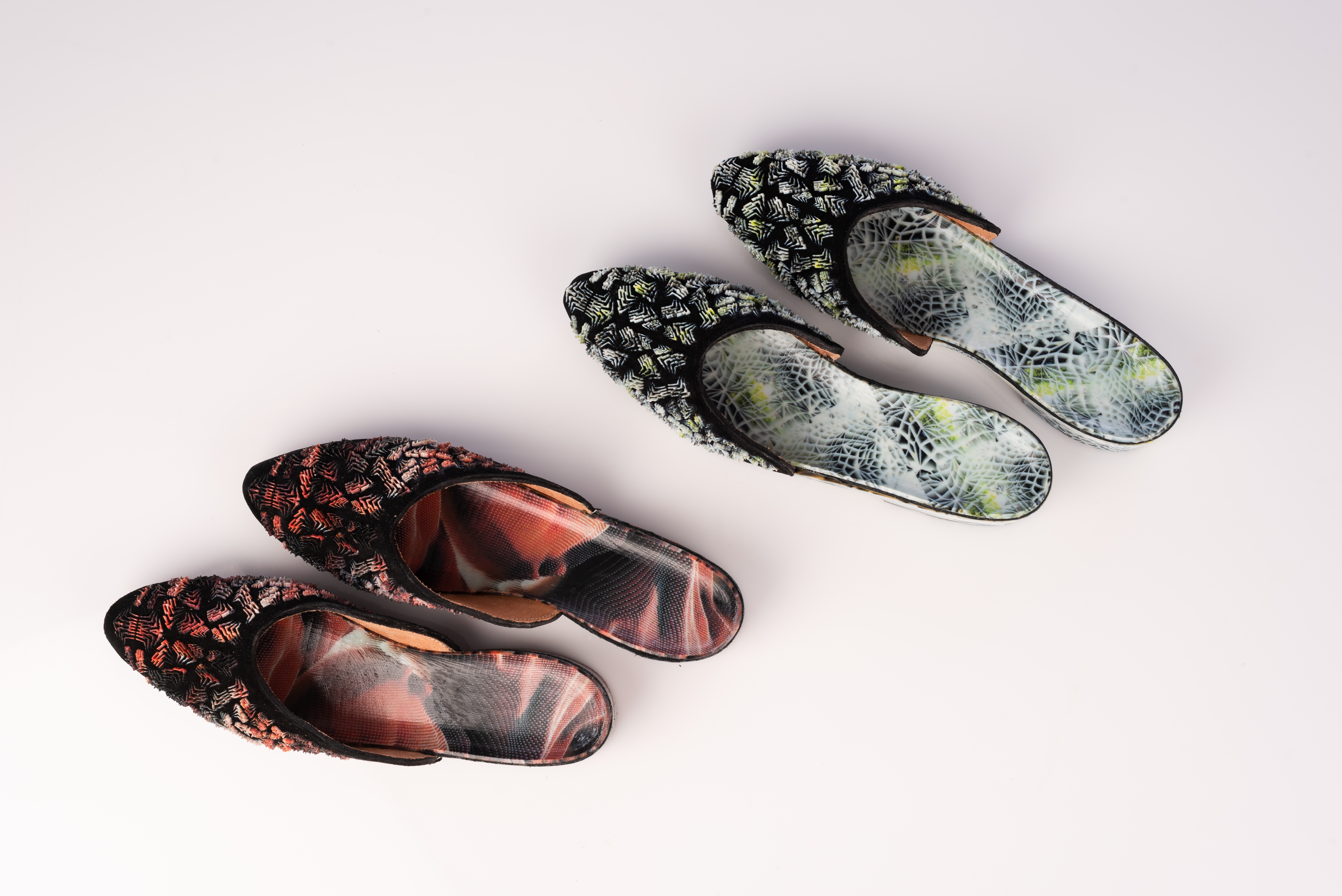
Ganit Goldstein is a Designer whose interest lies in the intersection between Craft and Technology. Ganit studied Jewelry and Fashion. She received the Excellence Award from Bezalel Academy of Arts and Design, Jerusalem, Israel. Her work is focusing on new methods of incorporating 3D Printing into the world of Textiles, Shoes and Fashion. In her Collection ‘Between The Layers’, she created garments and shoes, inspired by her study of ‘IKAT’ weaving in Tokyo, Japan. Her collection received great interest and immediate press recognition, and was presented at Exhibitions and Museums around the world including Milan Design week, New York Textile Month, Asian Art Musuem – San Francisco, Holon Design Museum, ‘TALENTE’ exhibition in Munich and more. Ganit Goldstein believes in an interdisciplinary approach to design- mixing Tradition with Futuristic techniques – 3D printing & 3D body scanning.
Give us some background on your experiences so far.
I studied at Bezalel Academy of Arts in Design and majored in the department of Fashion and Jewelry. Since my first year of study, I was fascinated by using 3D design software, especially because of the design-freedom it allowed me. During my studies, I have often incorporated tools from other disciplines into my work, whether it is CNC, laser cutting, 3D scanning and 3D printing. The use of different tools and mindsets helped me discover my own desig language.
During my third year of study, I was expected to participate in an exchange student program. My decision was to apply for the opposite direction of what I was used to. Meaning, the opposite of the cutting-edge technology field. I found my way to the Craft Department ’Textile Art’ program at Tokyo University of the Arts – GEIDAI. During this time, every single process of my designs was made using traditional handmade techniques. Meaning, I turned completely low-tech, changing my entire thinking structures and patterns. That was very significant for me in terms of expanding my horizons and changing my view on design. Talk about stepping out of your comfort zone! When I finished my studies in Tokyo, I went back to Jerusalem to finish my final project. That’s when I decided to combine the traditional methods I recently learned, with the latest technology I was working on before. This was translating both worlds of the past and future into one design language.
Since my graduation, I was lucky to participate as a finalist in four international competitions, presented my projects in New York Textile Month, Hong Kong Fashion Week, Asian Art Museum- San Francisco and ‘Talente’ exhibition in Munich. These competitions helped me a lot to reach my goals, discover possibilities, and meet great people that influence my work until this day.
Craft and Technology Outfit
When did you first get excited about fashion and design?
I was excited to mix the borders between art and fashion, back in high school, when my project consisted of dresses made from broken glass and metal wires. I was looking at garments as a platform to make art pieces, that aren’t necessarily meant to be worn, but rather a manifestation of aesthetics, culture, language, and design.
One exhibition that is very powerful in my memory is a solo exhibition (2014) of Iris Van Herpen at the Design Museum Holon. The exhibition was very special and it featured beautiful outfits, that crossed borders between art, fashion, and futuristic techniques. It was influential for me because it dealt, or perhaps answered the question of whether fashion can be presented at museums as art pieces.
When you did your first 3D printing project with fashion?
As part of my second-year curriculum study, we were asked to reconstruct costumes from the 18th- 19th centuries. I was asked to build an entire costume, made up of 7 different layers, just as it was made back in the history of fashion. The dress I was assigned to reconstruct is held by The Metropolitan Museum of Art (Costume Institute collections) – from the year 1870. This decade was a “golden decade” for lace dresses. In the next semester, we were asked to think about the outfit in a modern perspective, and I was focusing on the lace. I decided to design and create a 3D lace of our times, based on algorithms printed with hard material, combining flexible properties inside the printed part. This was the first time I used 3D printing as an integral working method in my designs, and that’s when I discovered the huge potential in using algorithms, software and parametric design in the process of my work.
During my studies, and especially due to this project, I began working closely with the Institute of Chemistry – Casali Center at the Hebrew University, for innovative research in 3D printing. The research group, led by Prof. S. Magdassi, focuses on materials science, nanotechnology and their applications in a variety of fields such as 3D and functional printing.
This collaboration gave me the opportunity to work with great researchers, and thus better understand the different approach for material research studies, working on innovations in the field of 3D printing.
How important is the differentiation of fully created 3D printed items vs hybridized fashion products from textiles and 3D printed material?
The harmony of putting together two different worlds makes the innovation approach, and bring forward a new way of thinking about design. I believe in taking the essence of the traditional techniques from our past and translate those methods to the new technology- a different point of view from the traditional technique inside the process of the newest technology.
I feel it is important to make the hybrid of textiles and 3D printing together because it has the power to bring 3D printing to a much more wearable level. I also understand that fully 3D printed fashion is still in a building stage, and the combination of traditional textile methods helps this method is growing quicker. Hybridized craft methods in 3D printing are important in my opinion because we should not lose sight of the traditional processes. Technology will always move forward, but craft methods can disappear easily. I believe it is important for the designers also to remember the traditional working processes, not to lose the history of crafts. Bridging the craft methods and technology to move forward with the latest technology.
Craft and Technology Shoe
What are some of your favorite projects that you have worked on in 3D printing?
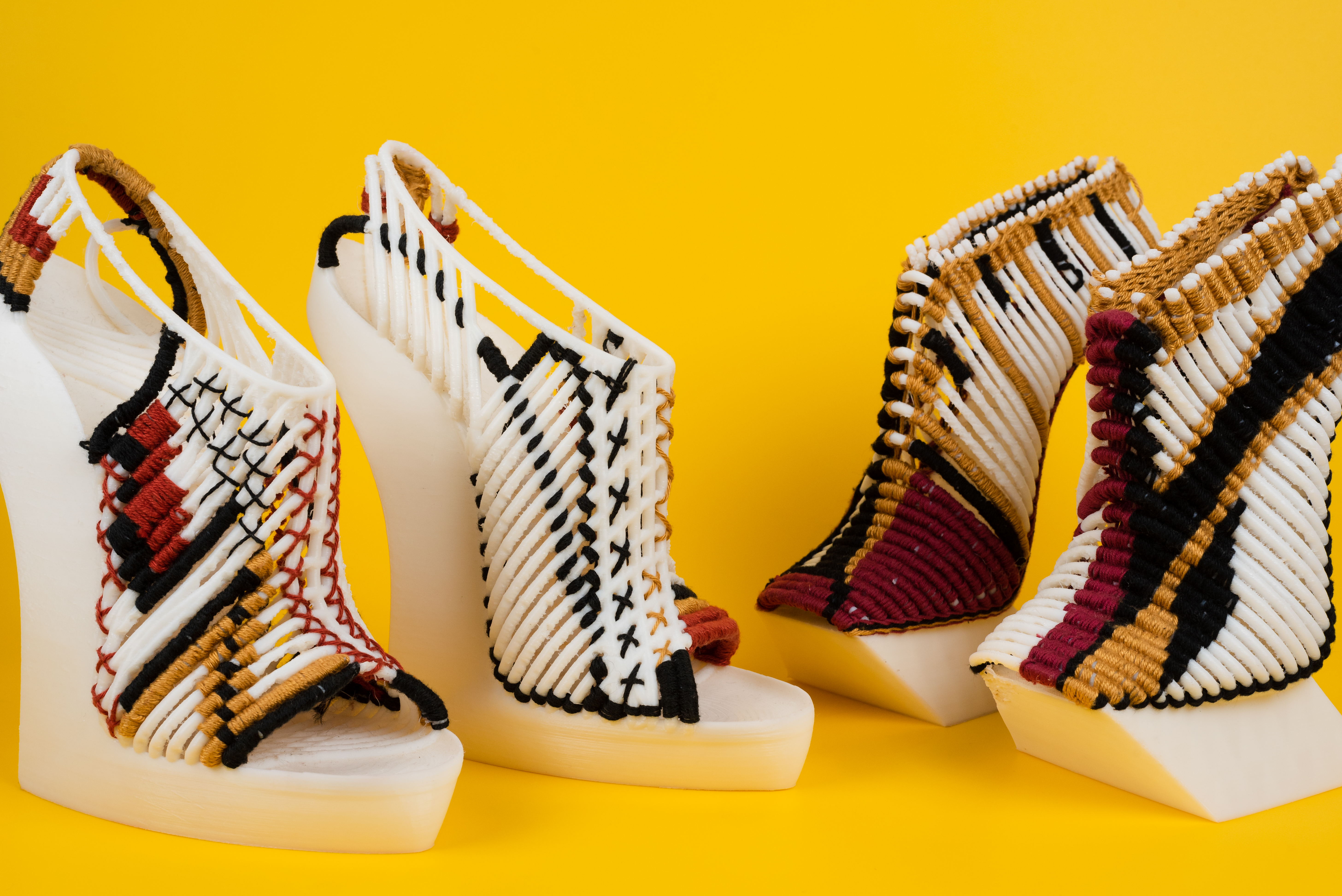
Seeing the first 3D printed multi-color shoes that were made in collaboration with Stratasys was an extremely exciting moment. In these shoes, my aim was to create a fabric-like texture inside the printing process. I couldn’t hope for better results. Since my graduation presentation, the shoes were presented in exhibitions worldwide (the last exhibition was in Milan Design Week 2019). Most of the people I have met during the exhibitions were sure the shoes are made from fabric and not from 3D printing. The shoes are now part of the Holon Design Museum permanent collection, they were the first pair I made together with Stratasys. We made a few more designs, but nothing compares to the success and joy that was brought by my first pair.
One of the most exciting projects that has had a huge impact on my projects so far, was working in collaboration with Intel ‘RealSense’ studio in Jerusalem. We incorporated their technology into the design process by 3D scanning an entire body thus allowing to create customized fashion and accessories, designed for a specific person. We also launched together an AR App (made together with Yoav from RealSense Studio) that demonstrates the 3D printing process using a hologram featured on the reality).
Another very exciting collection will be soon launched together in collaboration with Prusa Research company for FDM processes of wearable shoes. I worked closely with their maker-lab, and we made huge progress, the shoes are 100% wearable with multi-color and flexible materials!
Stratasys and Goldstein Collaboration
What is currently being worked on for you within the 3D printing world?
I am a great believer in collaboration and partnership with great people and open-minded companies. I want to continuously break boundaries, that is my core value, and I understand that in order to do that, I must turn to other disciplines and utilize what they have to offer. The ability to combine both worlds of past and future technique has a big impact on both my past and current projects. This is my take on the future of the 3D printing world.
Harnessing the power of the new technology and utilizing traditional techniques helped me create my own design language. I think that the ability to be open minded in the design process enables me to achieve my goals. I am a great believer of trying new methods, and not putting limits. This works because the design process has ups and downs, and from some failures and material tryout, you can reach better-designed results.
How was it to partner with Stratasys so early on in your journey?
My 3D printing journey started in a small room in my parent’s house, which I filled with 2 desktop printers. That room became my very own printing lab, where I got to experience, try-out materials and utilize the good old “trial and error” method.
I was fortunate enough to gain that experience, because I believe that is what enabled me to work with a “tip of the spear” company such as Stratasys.
The collaboration with Stratasys established after I had many “flight hours”, examples and tryouts. We partnered up during my last year studies. As my vision was to integrate colors inside my printed projects, They allow me to carry out my vision and turn it into reality. I’ve been incredibly lucky, and honored, especially knowing it came at such an early stage of my career. And it also makes me very proud.
I worked closely with the R&D team, and therefore, we shared the same vision of pushing the boundaries of the technology through design research. During the making process, we made some very interesting tryouts with the ability to control any voxel (3D pixel). At the same time, our research was growing, I made it into the final stage of numerous worldwide competitions and exhibitions (‘Talente’ & Milan Design Week), so we were continuing our collaboration for specific events that lead to new developments and exciting processes in each of the projects.
Woven 3D Print Shoes
Do you wish to branch out of just 3D printing?
I wish to further develop in the field of augmented/virtual reality.
3D printing is already well integrated into our lives and in many industries. From medicine to automobiles, furniture, military equipment, housing, fashion, etc.
I believe in the future of 3D printing and its applications. I also believe that 3D printing is directly linked to 3D scanning and ARVR applications and that this technology will completely alter the user experience in public sites and will be adding new features to the digital medium.
The adoption of the technology by museums to reach new levels of audience experience- multi sensational- rather than just viewing. I believe AR will soon be in every museum, using the newest technology for public use, and even controlling our experiences in different senses- not just by looking at an art piece.
I’m also very interested in the smart- textile field, adding new reactions for textile by using programming software. I find especially the 4D printing process very interesting topic to work on, creating 3D objects that change their shape over time.
What are some key skills needed to be a designer within the 3D printing world?
I believe that the main key is determination. Not to be afraid of failure. 3D printing can be very attractive on the one hand, but on the other hand, it is a relatively new technology, there are some limits and tons of failures in the making process. It takes time unti you figure out the path to the final project, it takes time and extra effort.
Being a Maker- For me, to be a designer in the 3D printing world means to be a ‘maker’, I believe in hard work from the beginning. You need to be experimental with many technology techniques. Building your own printer and so on are examples of how I describe a ‘maker’.
Professionalism and expertise- 3D designing and printing is just like programming. You must “study the language”. You must learn the 3D software skills, be an expert in your field. Luckily, in our times, this information is approachable by everybody via the internet. It is possible to study everything you set your mind to, every single feature is fully covered.
Independence and self-confidence – I believe to fully be in control of your designs, anyone that wishes to be a designer in the 3D printing world, should do the work on his own, and not rely on others people’s skills. The making process changes the way the final object will appear, and for me, this is the main freedom space, that you have the ability to bring your design from your imagination into reality and constantly improve it upon your request.
Who are organizations you want to partner or collaborate with in the future?
I want to continue my work with the partners that supported me and have been fantastic in our collaboration: Stratasys, Prusa Research and Swarovski.
I believe the future of my work also lays in collaborating with companies that have new technological developments and have design potential that can become a platform for combining my design visions. I would love to work with researchers of innovation in material research such as Neri Oxman and designers working in the field such as Iris Van Herpen. I’d like to extend the collaboration for shoe design with companies that develop 3D printed shoes such as Adidas.
Designers are not fully on the 3D printing wave just yet, how does it feel to be an early adopter?
It’s extremely exciting to be a part of a relatively small group that consists of designers and makers, who are investigating into how design can be developed in a sustainable and innovative way, using 3D printing technology.
This era is the most stirring time for pushing the boundaries of this technology, and I’m looking forward to working on new projects that will inspire me to think about “re-inventing” our future.
I feel that there is so much space for designers to grow in this field, working together with researchers and scientists all while keeping an open mind for new opportunities.
I feel blessed and extremely lucky to have become an early adopter in this field. It is a magical time filled with opportunities to seize and enjoy and to continue being excited from any new features, ideas, and projects.
I think 3D printing has great potential in so many fields, and design is one of the most exciting uses for this technology, clearing the way for further development of Art and Design (and maybe the concept of fashion and design as art), presenting each artist’s point of view the production process, from imagination to reality.
Where do you see the field of 3D printing and fashion in 5 years?
I see 3D body scan as a key process that will be an integral part of any fashion development department. I believe that 5 years from now, personalization will receive a different meaning and will bring a drastic change in the fashion industry, moving from mass production to one of a kind customizable piece.
In my opinion, another upcoming major change that will take fashion design forward is the ability to design your own clothing- the customer will be his own designer by, ‘pushing buttons’ (by simplifying the design and programming software) for producing his favorite design.
I’ve also found the development of flexible material as a very important process for 3D printed fashion, and the development of new material will be a major step for 3D printed textile to make 3D printing – wearable.
Where do you see yourself in 5 years?
With 3D printing and 3D scanning, we can utilize the new technology to develop tailored pieces and fit to measure clothing for individuals. I want to take this a step further and produce customized clothes, based on body scans, ready-to-wear fashion and I hope to have designers and partners in the future, bringing innovative approach into daily production methods of fashion.
In the next two years, I will be studying at the Royal College of Arts in London, in the master’s program for smart textile developments called ‘Soft Systems’.
I believe this upcoming period will greatly influence and affect my career, and I hope that 5 years from today I will be able to continue developing my design language, and open my own brand, start-up, lab and continue researching and developing the wearable technology field. I hope to continue being thrilled and excited from any new project, any new printing method and constantly breaking the boundaries of the latest technology
In today’s 3D Printing News Briefs, euspen plans to hold a Special Interest Group meeting in September centered around additive manufacturing, and an adjunct professor completed a comparison between a small SLS 3D printer and a large one. Moving on to interesting 3D printing projects, an artist teamed up with Mimaki to use full-color 3D printing to make a stage prop, a reddit user created an anti-cat button for an Xbox system, and an imgur user created a modular 3D printed fashion system.
euspen to Hold Special Interest Group Meeting on AM
The European Society for Precision Engineering and Nanotechnology (euspen) will be addressing the factors which are influencing an uptake of the use of additive manufacturing as a production technology at a Special Interest Group (SIG) meeting in September. The meeting, which will be co-hosted by the American Society of Precision Engineering (ASPE), will analyze the barriers to, and the opportunities for, the adoption of AM in production. It will be held from September 16-18 at the École Centrale de Nantes in France.
At the AM SIG meeting, issues that are, as euspen put it, “critical to the viability of AM as a production technology,” will be addressed. The co-chairs of the meeting are Professor Richard Leach from the University of Nottingham and Dr. John Taylor from the University of North Carolina at Charlotte. Local hosts and the organizing committee include Professor Alain Bernard from Centrale Nantes, Dr. David Bue Pedersen from the Technical University of Denmark, Professor Leach, and Dr. Taylor.
Comparison of Small and Large SLS 3D Printers
3D printers are often used in educational settings these days. Piotr Dudek, an adjunct professor at the AGH University of Science and Technology in Poland, runs a 3D printing lab at the school that both students and researchers frequent. While many technologies are used in the lab, SLS is the one that most interests Dudek, who decided to compare a big SLS system from EOS with the smaller Sinterit Lisa.
“We are using the big EOS SLS 3D printer for a long time and we wanted to compare it with Sinterit Lisa, check the possibilities of it. In SLS technology every detail matters. The temperature of the printing chamber, powder distribution system, heating or laser moving mechanism are very precise and important features. We wanted to test if Sinterit’s device is the valuable solution,” Dudek stated.
Larger 3D printers obviously have higher print volumes, but the down sides include difficult calibration, specialized training, and higher costs. In addition, it’s easy to mess up the calibration of a large 3D printer during transport. The Lisa 3D printer uses a gantry system, which comes pre-calibrated to save time, and it also uses less material, which means less money. The desktop printer is also much more student-friendly, making it the better choice for 3D printing labs like the one Professor Dudek runs.
Full-Color 3D Printed Stage Prop
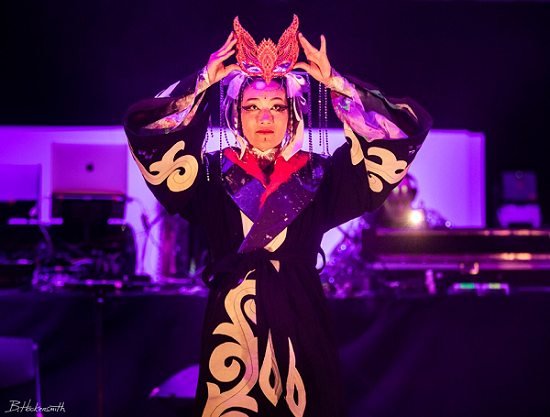
A few months ago, 3DPrint.com heard from 3D printing specialist and Post Digital Artist Taketo Kobayashi, from the Ultra Modelers community, about an art exhibit in Japan that he helped organize which featured colorful, 3D printed works created on the Mimaki 3DUJ-553 full-color 3D printer. Recently, he reached out to us again with news of his latest Mimaki Engineering collaboration – a stage prop for the Japanese artist Saori Kanda, who performed with techno/trance band Shpongle at the Red Rocks Amphitheater in Colorado.
“It is a artwork,” Kobayashi told 3DPrint.com, “but also a utilization of full color 3D printing to entertainment field.”
The “Shpongle Mask,” which took 28 hours to print and mixed in Asian details, was worn onstage by Kanda as she performed her painting live with the band.
3D Printed Anti-Cat Xbox Button
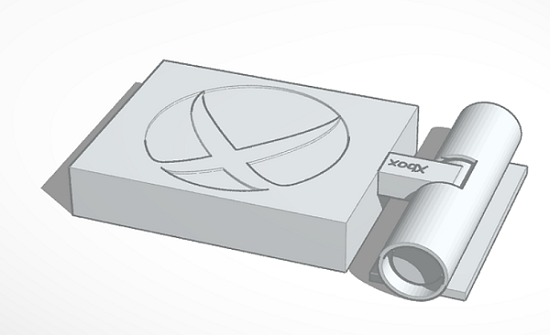
reddit user Mbiggz was getting sick of their cat turning off the touch-sensitive button on the Xbox console while it was in use, which I can understand, having two cats of my own. So Mbiggz came up with the perfect solution – a 3D printed cover for the button. The design can be found on the maker’s Tinkercad account, as Mbiggz originally made the design for a Digital 3D class.
“Adhesive goes on the back part (it is labeled in the print). I’m a newcomer in terms of this so it’s not perfect,” Mbiggz wrote on Tinkercad. “Also, the door doesn’t open all the way, so you can fix it so that it does if you want to (even though it doesn’t really matter, there’s not really a need for it to open it all the way).”
3D Printed Modular Fashion System
hunter62610, a young imgur user, designed and 3D printed a Lego-like modular fabric system, which was featured in his school’s fashion show. He made two dresses that are made with a 3D printed prototype fabric pattern called Escher, which was designed to be “put together and taken apart” hundreds of times. It took him just two weeks to make the material, which the two young ladies who modeled the dresses said was fairly comfortable.
“The idea of the system is that theoretically, one could buy a fashion catalog filled with designs, and say 5000 links. Once could make every clothing item in the catalog, based on there needs. Perhaps that’s a pipe dream, but it’s a fun idea,” hunters62610 wrote.
“The Escher system is quite versatile. Each link acts like a free flowing Equilateral triangle, and has a male and female ball joint on each side. Every individual link is theoretically compatible with every other link. Special links are stored in the middle of this pouch that are really 3 merged links with a screw hole. If needed, these links can be used as elastic tie down points or buttons, if you screw in the buttons i made.”
A Makerbot Replicator Plus was used to print the fabric links in unique, small panels.
Discuss these stories and other 3D printing topics at 3DPrintBoard.com or share your thoughts in the Facebook comments below.
The Metropolitan Museum of Art’s Costume Institute fundraiser event, better known as the Met Gala, has been referred to as the Oscars of the East Coast. This highly exclusive event heralds the arrival of the Costume Institute’s annual exhibition, and is a chance for fashion’s elite to strut their stuff. This year, famous designer Zac Posen, who launched his House of Z label at the age of 21, used 3D printing to go above and beyond on fashion’s biggest night. I was lucky enough to be invited to a luncheon in New York recently where Posen, and his collaborators GE Additive and Protolabs, discussed their teamwork over the last year to design and 3D print pieces for the 2019 Met Gala.
CNN’s Aileen Kwun asked, “What does it mean to be “camp” in our age of political absurdity, and of social media-driven of excess and spectacle? The Metropolitan Museum of Art’s Costume Institute will attempt to address the historical context and significance of camp in fashion for its next blockbuster exhibition.”
In this case, we’re not talking about camping in tents and sitting around a fire pit, but more artifice and theatricality. Sontag herself defined camp as being a “love of the exaggerated,” in addition to a “sensibility of failed seriousness.”
Exaggerated is right when it comes to Posen’s 3D printed Met Gala collection, but in the best possible way. The designer and his 3D printing partners combined AM technology with CAD, stalwart fashion design techniques, and conceptual thinking to come up with several beautiful and unique pieces for the star-studded gala.
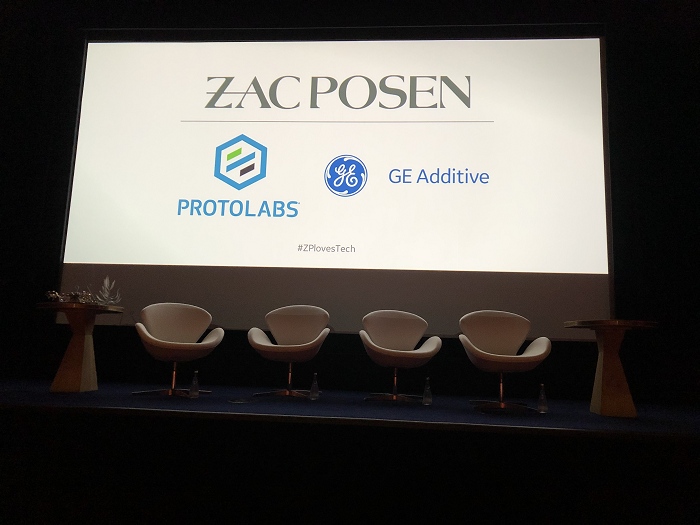
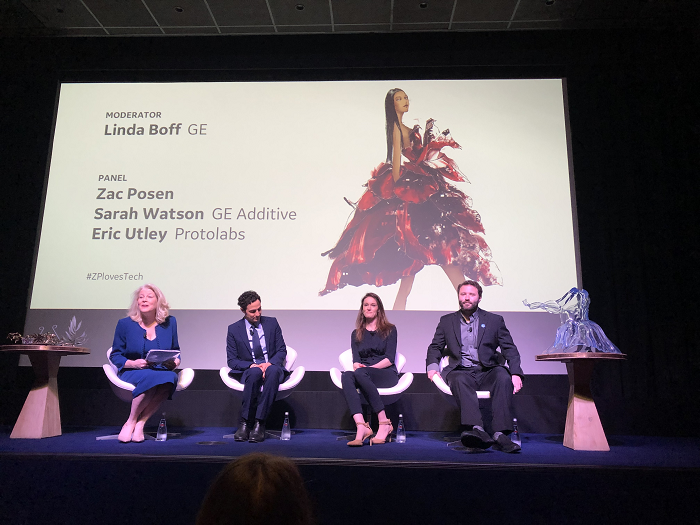
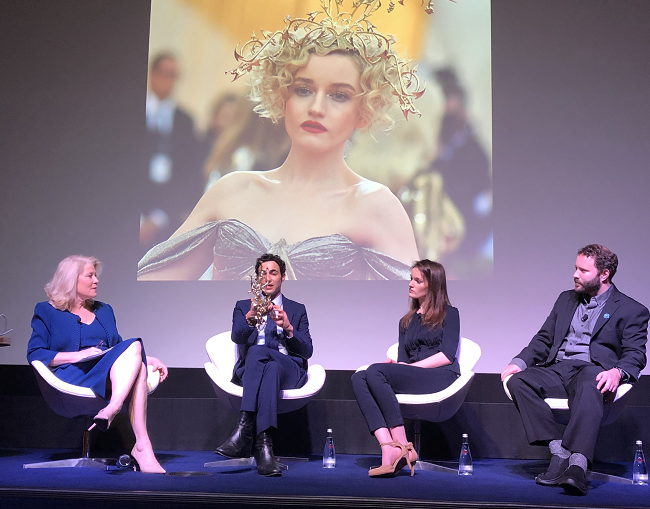
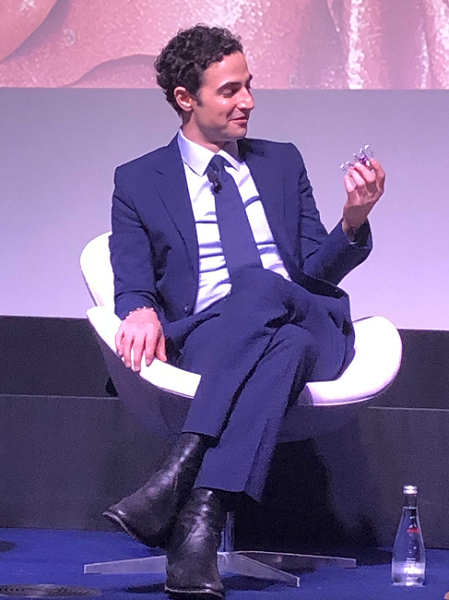
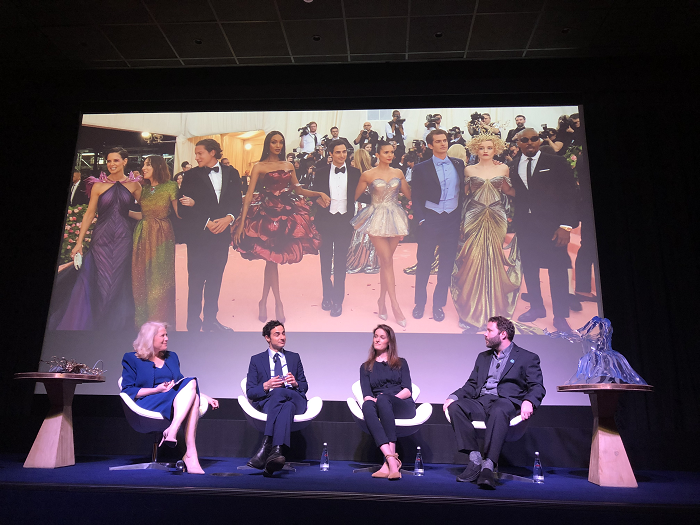
The event kicked off with a short video presentation before four people took the stage for a panel discussion: Linda Boff, GE’s chief marketing officer; Protolabs applications engineer Eric Utley; Sarah Watson, a design engineer with GE Additive’s design consulting team AddWorks; and Posen himself.
Zac Posen
The eye-catching collection was inspired by nature, and more specifically the idea of freezing natural objects in motion. Posen has always been interested in the fluidity of fabrics, and has long wanted to experiment with the use of 3D printing in his designs.
“I wanted to work in 3D printing for, I don’t know, 20 years, and I tried to get my hand into it a few times, and – you know, this was the beginning, I didn’t know what the capabilities were,” Posen said during the panel. “So it was the beginning of this quest and collaboration.”
In a serendipitous moment, he actually had dinner with Boff the day after the 2018 Met Gala, and the collaboration was born when they realized that the 2019 event would be the perfect opportunity to mix 3D printing with high fashion.
“Then I did a trip to Pittsburgh and had a million and ten questions about plastic molecules, what’s possible, you name it,” Posen explained. “And then they kind of started to say, ‘Well, what do you want to start dreaming?’ And I talked about natural form, because I like to garden.
“Our greatest innovator and scientist is Mother Nature…that was really the start.”
Over the last year, the partners have been hard at work creating some absolutely stunning pieces. Posen and his creative team worked with the 3D printing experts and design engineers at GE Additive and Protolabs to explore multiple digital technologies – GE Additive brought its experience in additive design for multiple modalities, mechanical and industrial design, and creative and complex CAD modeling to the table, while Protolabs supplied its industry expertise from a wide range of manufacturing industries, materials, and processes.
Posen stated, “I dreamt the collection, GE Additive helped engineer it and Protolabs printed it.”
It took many, many hours of 3D printing to complete the collection for this year’s Met Gala – Posen and Boff said that the collaborators spoke with each other daily – and several of the garments were actually fitted to exact 3D recreations of the bodies of the people who would be wearing them; according to the Hollywood Reporter, Posen invited nine guests to the event, but only some of them rocked 3D printed pieces on the museum’s pink carpet.
The great thing about 3D printing is the freedom it offers, which allows users to fabricate designs that would have been extremely difficult, or even impossible, to make using traditional forms of manufacturing. Additionally, there are many available custom finishing options for 3D printed pieces, in which Posen was extremely interested.
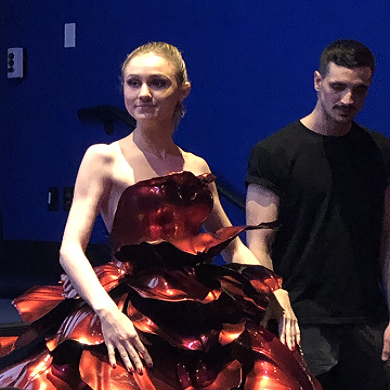
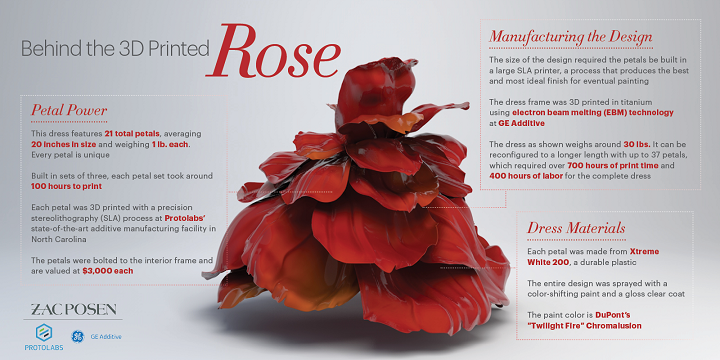
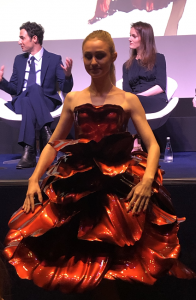
At one point early in the discussion I was looking down while writing notes, but my head quickly snapped back up when I heard multiple intakes of breath around me as a model walked into the auditorium wearing one of the stunning Met Gala pieces: the Rose Dress, worn at the previous night’s event by British supermodel Jourdan Dunn. The model walked slowly back and forth in front of the room so that everyone could get a good look at the amazing dress, which is based on the structure of a real rose.
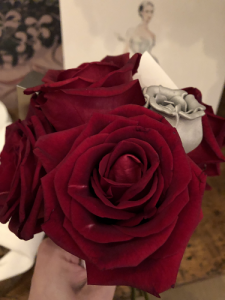
The custom gown has 21 unique 3D printed petals, each one weighing 1 lb. and averaging 20″ in size, made out of Accura Xtreme White 200 durable plastic and printed on an SLA system. Primer and color-shifting automotive paint from DuPont were used to finish the petals, which are actually held in place on a modular 3D printed titanium cage that’s completely invisible from the outside of the dress. The cage was 3D printed on an Arcam EBM system at the GE Additive Technology Center (ATC) in Cincinnati, Ohio, while the gown itself was fabricated at Protolabs’ North Carolina facility; the 3D printing and finishing of the Rose Dress took over 1,100 hours.
[Image: Protolabs]
According to Posen, the first petal prototype was a little too heavy, and the team had to determine how to reduce the weight by 20%, in addition to balancing stiffness with organic movement and adding a buttress underneath for extra support of the titanium frame. Watson explained that the dress design was very modular, and the cage itself is adjustable.
“Our role as design consultants is to come in and have this immersive relationship with the customer,” Watson explained onstage. “So this was kind of an example of any other project we’d do with other industries, but slightly more, I think extreme, in just having us understand and start to work with each other. So Zac would give us feedback, like ‘It needs more energy and motion,’ and I was like, do you have a dimension for that?”
Everyone in the room laughed at this, particularly, I’d say, those of us from the manufacturing industry, and Posen continued her thought: “What do you mean by energy?”
Watson continued, “But then we started to ask questions and we started to work together and kind of understand what that meant. And by the end, it really started to click.”
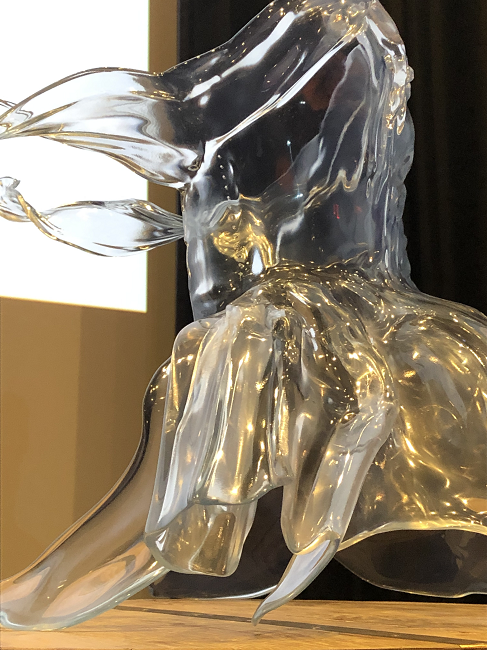
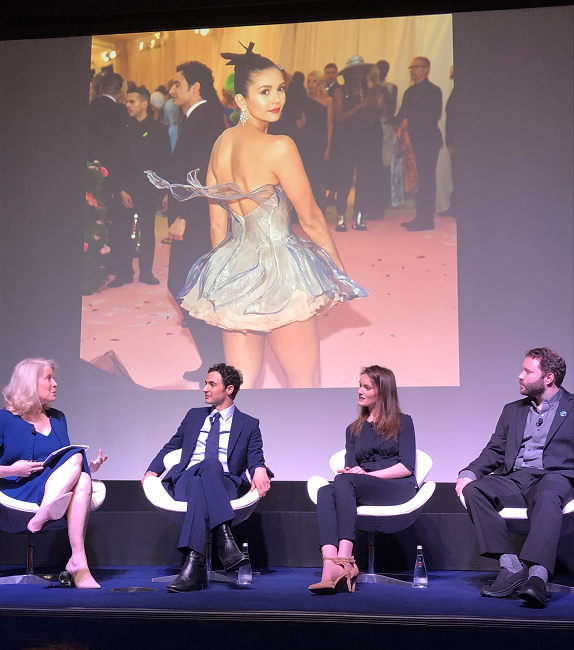
She said that the 3D printed clear bustier the team made for actress Nina Dobrev to wear was a good example of the company’s partnership with Posen really picking up steam.
“We worked really hard on the front of it, took a long time iterating back and forth to get a front that you really loved, and then on our last visit to New York, you said, ‘Let’s just add some twists at the back that look like they’re floating away in the wind,’ and I was like, ‘All right, I think I know exactly what you want.’ So we started to learn how to work together.”
The bustier – a clear dress 3D printed on an SLA printer – is the only piece of the Met Gala collection to be created at Protolabs’ German facility. Posen told us that it actually got held up on the way over to the US because the customs officials thought it was an art piece, to which Boff responded, “It is an art piece!”
The interior of the 3D printed dress perfectly matches Dobrev’s 3D recreation, and comes in a 4-piece assembly for a truly custom fit. The first version was not as translucent as Posen hoped, so to get the glassy, liquid appearance of the final piece, Protolabs used Somos Watershed XC 11122 plastic, then finished it by wet hand sanding and spraying it with a clear coat.
All told, the 3D printing and finishing of the bustier dress for Dobrev took over 200 hours.
“I think it’s really funny how this is fashion, but we were using a lot of the same plays in the playbook that Fortune 500 companies use to develop their products,” Utley said at one point during the discussion.
He said that the team made scale models and combined them with 3D CAD files to give Posen a better idea of what a piece would look like before printing even began. Watson noted that the same kind of problem-solving and engineering can be applied whether GE Additive and AddWorks are completing design projects for the aerospace industry or for the fashion world.
“When you’re trying to solve these problems of how do we print this, how do we design it for additive, how do we assemble it so that it assembles in a way that you really can’t tell how it was put together, those types of problems really apply across many different industries,” Watson said.
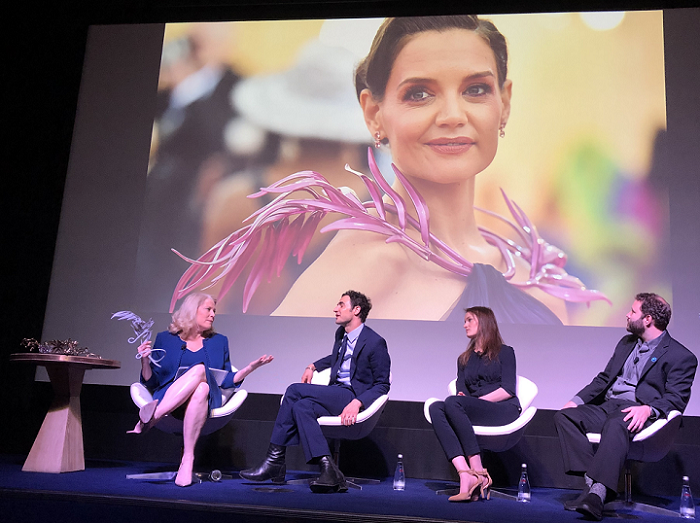
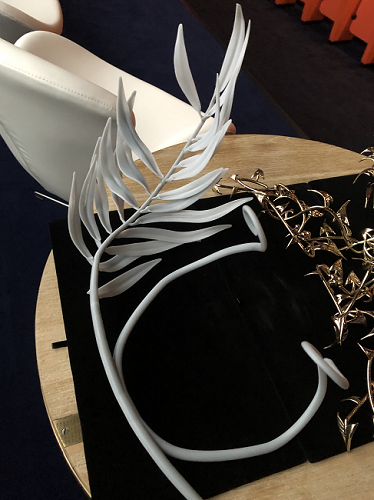
While the 3D printed Rose Dress and bustier are both beautiful and unlike anything I’ve ever seen before, the third of the Met Gala dresses we talked about is my favorite – a custom, purple Zac Posen gown, with a 3D printed palm leaf collar accessory, worn by actress (and Ohio native!) Katie Holmes.
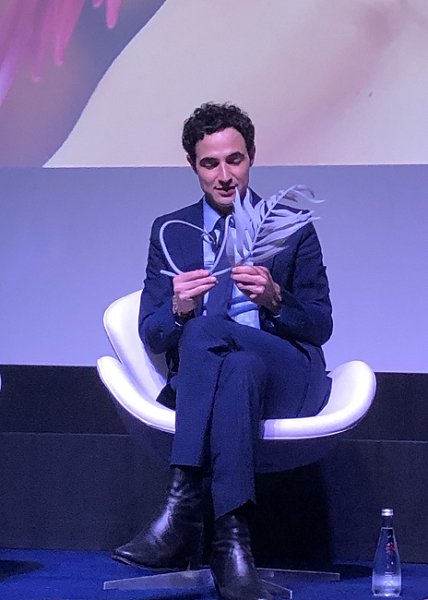
While Posen did not have the neckpiece itself, which was 3D printed at the North Carolina Protolabs facility on an SLA system, he did bring the mold for it to the panel. He explained that he waited for the 3D printed neckpiece to fully evolve before he got to work on the draping of the beautiful dress, which he described as “1950s-quality” and like a “purple sunset.”
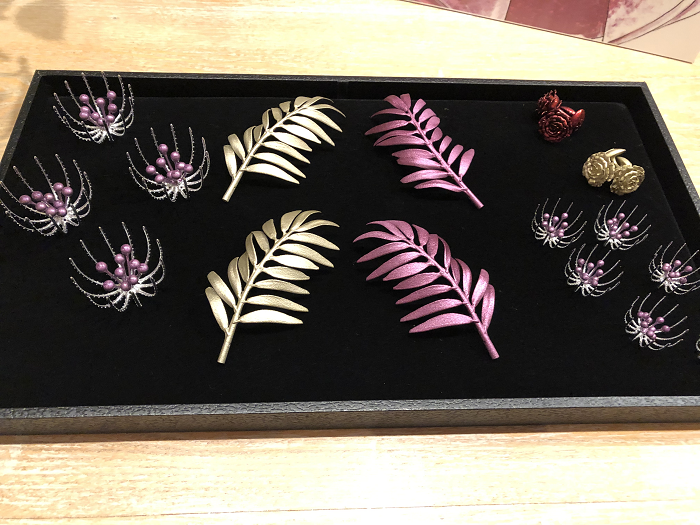
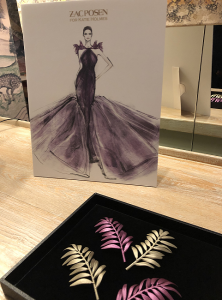
The pearlescent palm leaves were 3D printed out of Accura 60 plastic and finished with pearlescent purple paint (Pantone 8104C). The piece drapes over the actress’s shoulders and attaches to the neckline of the tulle gown at her clavicle. It took over 56 hours to 3D print and finish the palm leaves for the striking neckpiece.
Watson explained how Posen found a palm leaf he liked from his favorite craft store and sent it to GE Additive, who laser scanned it to make a 3D model. After the model was cleaned up and modified, the designers added a twist so that it would perfectly match and “float away over” her shoulder.
“That just demonstrates the power of this technology – you can start with this inspiration and modify it, add all the complexity you want, bring the vision to life in the 3D model, and then create it,” Watson said.
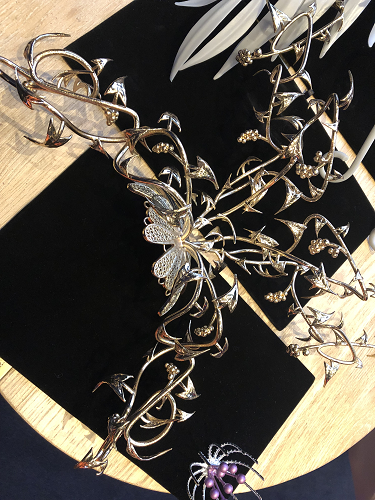
Moving on, Boff picked up an intricate 3D printed vine headpiece, flush with leaf and berry embellishments and finished with brass plating, and remarked that she was scared to even hold it. Posen told her not to worry, as the headpiece, worn by actress Julia Garner at the 2019 Met Gala, was made of nylon.
Garner wore a custom Zac Posen ombré silver to gold lamé draped gown with the headpiece, which was printed as a single piece with binder jet technology on an HP Multi Jet Fusion system.
The headpiece, which features a butterfly in the center, was the fastest piece of the collection to make: 3D printed with no supports, plated, and finished in just over 22 hours at Protolabs. It was a comparatively quick job, and the team commented that there is no way they could have made the headpiece through more conventional forms of manufacturing.
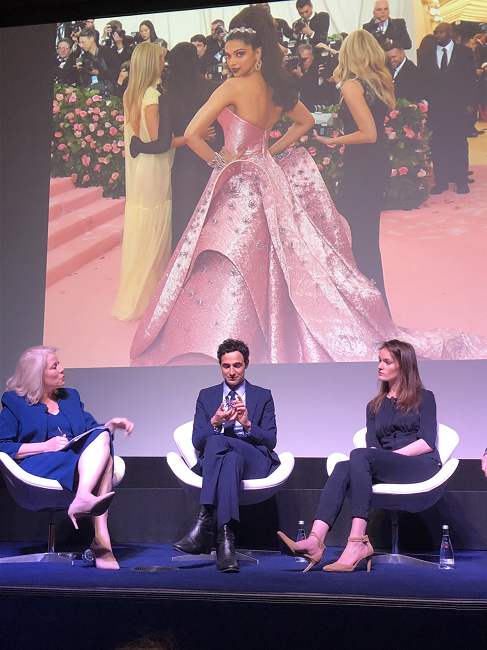
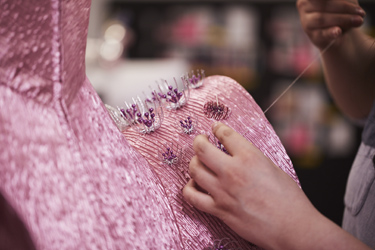
The final piece in the Met Gala collection was a custom Zac Posen metallic pink lurex jacquard gown, worn by Bollywood icon Deepika Padukone, that included delicate 3D printed embroidery which Posen described as “a little sci-fi” and was inspired by underwater creatures like sea urchins and anemones.
The 408 pink and silver embroidery pieces, 3D printed on an SLA system at Protolabs out of Accura 5530 plastic, were all different sizes, and were actually sewn on to the outside of the gown. But before that happened, the pieces were vacuum metalized and center painted with Pantone 8081 C; the 3D printing and finishing work on the embroideries took over 160 hours.
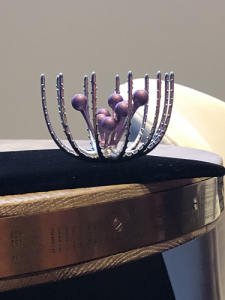
At the Met Gala, Posen and two of his other guests also wore 3D printed accessories – the designer added 3D printed lapel brooches to his ensemble that were essentially a scaled down version of the large palm leaves that made up the 3D printed neckpiece. 3D printed out of high resolution Accura 5530 material on both SLA and MJF machines, these brooches were finished in pearlescent purple and gold paint.
Additionally, Vito Schnabel and actor Andrew Garfield both wore 3D printed cuff links that integrated Posen’s logo and represented a scaled down version of the Rose Dress. The cuff links were 3D printed out of MicroFine Green material on an SLA 3D printer and dramatically finished with color-changing red and gold paint.
The four panelists then took some questions from the group, and one of the first people to get the mic wanted to know what had surprised each person about the collaboration. Posen said that all the partners began to learn one another’s vernacular during the process, while Utley stated that the evolution of the project was surprising and Watson continued, noting that “Zac wanted to go bigger and bolder than other 3D printed fashion.”
“It can be hard to conceptualize something like this,” Watson continued. “But this is a great demonstration of what the technology can really do.”
Utley stated that the fashion collaboration took advantage of two important things 3D printing can offer – lightweight designs and mass customization.
“Let’s give credit where credit is due – aerospace and medical get a lot of noise for adapting 3D printing, but like Zac said, he was using 3D printing ten-plus years ago, and it [fashion] is well-suited for those aspects,” Utley said.
Posen said that he was “very proud” of the partnership with GE Additive and Protolabs, and that he was able to work with the two companies to “bring motion and life to technology.”
“Had we not had a partner in Zac Posen, who literally thinks in 3D, this never would have happened,” Boff said about the Met Gala collection. “It was a project of tremendous joy and passion, and to see it come to life on the steps of the Met is a once in a lifetime experience. It was just incredible.”
When asked what she had learned from working with Posen, Watson stated that AddWorks and GE Additive will typically use CAD software for more industrial applications, but that they had needed to shift and become more familiar with using other software, such as Rhino and Blender, in addition to photogrammetry, for this particular project. Speaking of software, Posen was asked if the collaboration would change how he designed clothes from now on.
“I would love a software that will let you model fabric and draping,” he answered. “And we’re getting there!”
[Image: Protolabs]
Another person asked the question that is always on my mind when it comes to 3D printed clothing – what does the path look like to consumer 3D printed fashion? Many designers are working to use the technology to make wearable clothing that’s less of a novelty and more for everyday use, but that can sometimes be easier said than done. But Posen had a great answer, and stated that the next big challenge was dealing with closures for clothing.
“What’s the new zipper?” he asked.
As most of us aren’t lucky enough to have an army of people helping to dress us, or own clothing made to perfectly fit our bodies, this is a smart question to be asking. Posen also said that we have a long way to go in replicating fabric, and that further advancements in both scale and material are still to come in the future. Watson also chimed in and said that 3D printing could easily be used to make molds in the fashion industry.
Boff thanked the teams from GE Additive and Protolabs for their “remarkable” patience, flexibility, and commitment, and said that the project shows how 3D printing in any industry, fashion or otherwise, is really about “working your way back from a problem.”
“And in this case, that problem was dressing five gorgeous women,” Boff said as everyone in the room laughed. “But it is something that applies to so many different industries, and I just think for all of us, this can sound a bit fantastical, but 3D printing is real.”
3D printing is still growing faster than any other type of manufacturing technology at the moment, and the fashion industry, as well as other applications in consumer goods, can really use the technology to its advantage to help the market evolve. Posen has said that the 3D printed Met Gala collection is an example of fashion as an art form, and not the standard in terms of mass adoption. But, while we still can’t walk into Macy’s and purchase our own 3D printed Rose Dress just yet, I think that day is coming.
Check out some more pictures from my trip to New York below:
Discuss this story and other 3D printing topics at 3DPrintBoard.com or share your thoughts in the Facebook comments below.